Wednesday, December 31, 2014

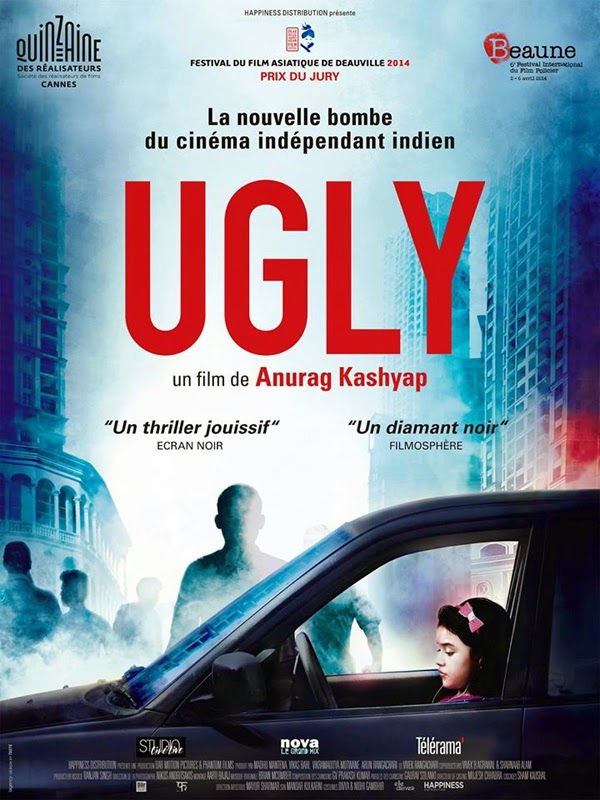
'Ugly' is Beautiful

And yet another year ends. Not such an eventful year but yes, a rather good one. At least nothing bad happened to me. In this world, at such a time when the human behaviour has gone to such a negative level that anything bad can happen to anybody at anytime, I am rather pleased that I was not at the receiving end of any such mishappening. Anyways, this very blogpost is not yet another typical year ender blogpost. This is about Anurag Kashyap's recent release 'Ugly', about the film and about that same negative human behaviour that the film is all about and what I was referring to earlier.

'Ugly' was premiered at last year's Cannes film festival in director's fortnight section and has been making news since then. First for its wonderful response at the premiere and then for the controversy regarding that "smoking is injurious to health" message forced to be put in by the indian censor board, it was always in the news for all sorts of reasons. With the limelight, the wait and anticipation for the movie was also increasing and that's why I couldn't wait for much longer after its release. And after watching the movie, I must admit the wait and anticipation was all worth it. It is simply the best movie that I watched this whole year and also amongst the best that I ever watched.

Ugly on the outset is a story of the kidnapping of a 10 years old girl who is the step-daughter of a top cop of Mumbai police. She was away with her biological father on the routine weekly meeting day (as per divorce settlements) when she was abducted in the broad daylight. The incidents that follow is the whole movie. The police investigation, the trust issues, the betrayals and the greed everything characterises the theme of the movie and at the end the kidnapping comes out to be the side plot of the movie. The movie comes out to be all about the human behaviours, the greed, the distrust and the vengeance.

The movie starts off with a chase sequence wherein the biological father of the girl and his friend are chasing the suspected kidnapper in the streets of movie. Being an Anurag Kashyap fan, you are reminded of the iconic chase sequence from the movie Black Friday. As the scene goes on building upon you and you start to have that feel of Kashyap's film-making, bam, the suspected kidnapper is struck by a running car. His body parts are shattered all over the road and the first indication of the ugliness of the movie is there before you. The scene moves to that of a police station wherein the complaint of the kidnapping is being lodged.

There are many good sequences in the movie but this police station sequence, in the hindsight, appears to be the best of the movie and one of the best noir-sequences of all time. The sequence moves from the hapless father lodging the complaint to him teaching the police officer how to take and save pictures in contacts of his phone. The scene seems to overstay its welcome and looks like it is stretched just too long. You laugh at the irrelevance but then in the end of the movie you are struck by the fact that this very irrelevance is the total theme of the movie. The whole movie seems to be about the suspense of the kidnapping interspersed with too many irrelevant sub-plots. Sometimes even these irrelevant plots would irritate you but then at the end of it all you find out that these irrelevant sub-plots were actually the main plot of the movie.

The love triangle of the campus in the backdrop leading to the revengeful acts in the present, the seduction of the husband's friend just in reply of a casual appreciation of her beauty, the greed for money are all the sub-plots of the story. They seem to be irrelevant but in the end lead to the grotesque climax. These human behaviours lead the police investigation to a total awry path leading to an ugly end of, what in the end seems to be, a shameful story.

Anurag Kashyap is totally back in the form with his dark comedy shot in the filthy dark rooms of the Mumbai suburb. If he has to do the useless cameos in movies like Happy New Year and Bhootnath Returns to earn money to make movies like this, I am all okay with it. The way he has used all the actors is just commendable. Ronit Roy as the cop has come up as the most dependable actor lately. He is still in the 'Udaan' mode and seems too comfortable as a tough cop and a stern authoritative husband. Tejaswini Kolhapure as the alcoholic wife and Rahul Bhat as the struggling actor and the divorced biological father  have done justice to their role. Special mention must be made of two actors. National award winning marathi actor Girish Kulkarni and Vineet Kumar Singh are more than impressive and must be appreciated for making few of the sequences of the movie special. Dialogues are raw reminding you of the dialogues from a Tarantino movie. The background score keeps up with the tone of the movie. All in all, I must say, 'Ugly' is beautiful.

[In the end, a scene from the movie. Just watch out for Girish Kulkarni:]


Wednesday, May 14, 2014

A Tale of Two Cities

The recent surge rather resurge of my enthusiasm towards literature has led me to finish yet another novel. This one is a classic from Charles Dickens, written in the middle of the nineteenth century (1859 to be precise) about a period somewhere six or seven decades further earlier. A Tale of Two Cities, at the outset is a story of the French Revolution (at least as told in my ebook copy that I got from the internet). Searching on the internet for something to read (that too for free) led me to this book, the author of which I had heard something about. In our school textbooks there were some of his stories in the curriculum to be read, Christmas Carol being the one that I still remember.

Due only to the familiarity with the name of the author, I started reading the novel. I had only the slightest of the ideas about the context of the storyline that I got from the small description of the novel at the site from where I downloaded it. I searched about the book on the internet and categorically avoided the plot of the story. The ideas that I started the novel with included the fact that it was a story of comparison of lives and times in the two cities, namely London and Paris in a period just before and during the French Revolution and that it was written by Dickens as weekly instalments to promote the sale of his magazine 'All The Year Around'.

The very first lines of the novel give you the idea about the comparison of the state of the two cities at that time. The differences as contrasting as they were and the similarities between the two cities as parallel as they were were quite evident in the opening lines of the novel. A thorough search about the novel that followed my finishing it revealed to me that these opening lines written more than one and a half century back are one of the most popular lines ever written in english literature.
"...It was the best of times, it was the worst of times, it was the age of wisdom, it was the age of foolishness, it was the epoch of belief, it was the epoch of incredulity, it was the season of light, it was the season of darkness, it was the spring of hope, it was the winter of despair, we had everything before us, we had nothing before us, we were all going direct to the heaven, we were all going direct the other way...  
...There were a king with large jaw and a queen with a plain face, on the throne of England; there were a king with large jaw and a queen with a plain face, on the throne of France. In both countries it was clearer than crystal to the lords of the State preserves of loaves and fishes, that things in general were settled for ever..."
The description of the differences very well explain the tortured condition that the people of France were living in. The way Dickens has drawn similarity in between the two places here must only be his foreseen warning of the fact that if aristocracy is continued in the same manner, even England one day could fall to a similar revolution of sorts.

The whole plot of the story can be found here. The story moves slowly and steadily from being one of comparison between the two cities to one filled with humanly emotions of love, sacrifice, sufferings, life and death. The first half of the story is spent in building up the whole melodrama that the latter half is all about. The extensive build-up of the first half sometimes feel boring and one tends to loose connection with the book altogether.

There were a few times in my reading the novel when I seriously wanted to just put it way. The sheer number of novels that I have kept unfinished became my biggest motivation to finish this one off and I must be thankful that I finally managed to finish it and experience the melodrama that Dickens has put in the climax of the story. Altogether, it is really tough for an early bird like me to comment something on an age-old classic like this one. I must admit, the way the climax of the story has managed to amaze me, it was out of proportions from what I had expected while reading the earlier half of the novel. Must recommend it to those who can have the patience to tolerate the somewhat trivial first half to enjoy the more than exciting climax.

Thursday, April 3, 2014

The Unfinished Ones...

“...I had one last chance to make a decision. One final opportunity to decide who I was going to be. I could step into that alley, stand up for Hassan--the way he’d stood up for me all those times in the past--and accept whatever would happen to me. Or I could run. 
In the end, I ran...”
Well, there have been times, in fact too many of them, in my life when I have strived hard to be a reader. A simple reader. Hearing something about some novel or biography or anything has always managed to intrigue me with trying my hand at reading it. Some of my earlier posts on this blog have been on my time-outs with certain books some that I started and a few that I managed to finish.

To go on with a book to the level where it actually finishes has always been difficult for me. Lack of concentration towards reading can not be blamed for this in any way. Being in a profession wherein you are a student for life, you just can't have that lack of concentration. But then yes, reading and studying are totally different things altogether.

Anyways, there has been many a books that I have started in the past and left them without ever finishing them. I remember Kazuo Ishiguro's The Remains of the Day. I probably started reading that book somewhere in 2001 and then I had to restart it a whole lot of times before somewhere in 2009 that I finally managed to complete it. There were a few books that I started and completed too but recently, over a couple of years, again that same string of starting and then leaving a book unfinished is  continuing with me as if it was a curse.

I remember, I started them all, Dickens' Great Expectations, Dostoyevsky's The House of the Dead, Wilde's The Picture of Dorian Gray, Mario Puzo's The Family amongst others. The Family is still placed in front of me on my table but all of them have been left unfinished. I just don't know where did I lose them. Anyways, even after all these unfinished books all in front of me, I have been starting new ones. There is the hope that they won't end-up like these and then there is the fear of the contrary.

Siddharth Mukherjee's The Emperor of all Maladies: A biography of Cancer and Khaled Hosseini's The Kite Runner are the recent addition to the ever increasing list of my tried books. Incidentally, this time both these books have managed to mesmerise me in some way or the other. Hopefully, both these books will not remain in that same expanding list of my tried books but will find an entry into a somewhat constant list of my finished books.

I am really close to finishing The Kite Runner. I am totally mesmerised by the way this beautiful yet grotesque story has been written. The way it leads you to feeling really bad about the protagonist and the way the story unfolds and leads you to the lively scenes of a politically unstable and socially robbed Afghanistan is simply awesome. More on the story and my thoughts about the book, I will try to put in my next post once I finish the book. Till then, another excerpt from the book giving the vivid details of the street of Kabul that must have been present there in the tougher times.

“...RUBBLE AND BEGGARS. Everywhere I looked, that was what I saw. I remembered beggars in the old days too--Baba always carried an extra handful of Afghani bills in his pocket just for them; I’d never seen him deny a peddler. Now, though, they squatted at every street corner, dressed in shredded burlap rags, mud-caked hands held out for a coin. And the beggars were mostly children now, thin and grim-faced, some no older than five or six. They sat in the laps of their burqa-clad mothers alongside gutters at busy street corners and chanted “Bakhshesh, bakhshesh!” And something else, something I hadn’t noticed right away: Hardly any of them sat with an adult male--the wars had made fathers a rare commodity in Afghanistan....”

Tuesday, January 21, 2014

AAP, Kejriwal and Media Sensationalisation

The new smart-phone and internet era has really changed the world tremendously. Sitting in my hostel room, most of my time is spent either in front of my laptop surfing on the internet or on my phone replying to those messages on whatsapp or looking at the twitter notifications therein. (For my family members who still are bothered about my studies, I must make it clear that this time that I just talked about is exclusive of what I spend with my books.) When at home, thanks to the limited availability of internet, passing time on the television remains my favourite. Writing blog used to be one of the better pass-times that I ever had but due to some reasons or the other, it was discontinued. I wasted a whole post (in my hindi blog) on why I am not regular on my blogs and hence, am not going to bore myself with same thought again.

Surfing the internet or following the twitter trends, recently, I have been brought much into the current affairs. I was never a big fan of current affairs, especially, politics. I already started hating the news channels some 5 years back or even more due to their repetitive sensationalisation of issues and the ongoing race for TRPs. Since the time the news channels have started following the trends in TRP, I think the decline in their credibility has started and till date has reached at a level from where the return back is not possible at all. Be it a real important news or just the trend of TRP, each and every forum of news distribution is following only one thing these days, Aam Aadmi Party (AAP) and Arvind Kejriwal. (I purposely left the 'Mr.' before his name as I thought it might bring him into that VIP list that he has always had aversions with.) 

As I am writing this post here, Kejriwal and his AAP is busy on the streets of Delhi with his dharna and the news channels are even more busy capturing it with all the angles possible. There are reports going on, interviews running, panel discussions on roll, articles flowing, and everything else that can be shown or written is being done. All of a sudden AAP is the rage of the nation, a new voice, a new face. Only time will tell that the dharna going on in Delhi is a real political breakthrough or just a gimmickry of some self-righteous people. Whatever it comes out to be, it is too very clear that it is a result of that same over-sensationalisation of issues and facts that I blamed the news channels for. Just would want to put one question here. Would this chaos that is going on in the streets of Delhi had the same magnitude had the news channels opted for a simple news-telling rather than the over sensationalisation?

Last month when I was at home in my vacation, AAP had secured the historic victory in Delhi assembly polls. I had some arguments with my cousins on AAP's impractical promises and about my skepticism regarding the ability of this bunch of newly elected legislatures. My cousin sister named my skepticism, my cynicism. Looking at the chaos that these people are creating in Delhi, I think my doubts are now transforming into my beliefs. I doubted their inability to govern, they are making me believe that they really can't.

Any of their efforts towards governance is being hindered a great deal due to the media that just propels anything or everything that anybody wearing the aam-aadmi-topi says. The assembly polls were held in five states. The perennial negligence of the media towards news from north eastern states led to a total invisibility of election news from Manipur. The other four states got almost equal footage till the time AAP came up with as many seats as they got in the election results. The moment after, everything was AAP and only AAP. Delhi was seeing a change in governance so did Rajasthan. The news from the other three states died. After the swearing-in drama that was played in Ramleela maidan in Delhi, my cousin brother came to me and just informed me that Kejriwal has kept home department with himself and Shishodiya got the education. I smiled and asked him, when did the swearing-in of new government in other three states took place. He couldn't answer.

Why this overhyped coverage of the Delhi election results and the proceedings thereafter by the media is something to think about. No doubt, that the spectacular debut by the AAP in electoral politics in India is commendable but the fight-back and return of Vasundhara Raje in Rajasthan that too after she was almost ousted from the party is also no less. For that matter, even Shivraj Patil managed to score another point in his race of good governance against Narendra Modi by securing another victory in MP. That too could come into limelight but no, media chose Kejriwal and AAP. Kejriwal took the credits for his idea of Janta Darbar in Delhi (that failed due to ill-management on its very first day) but everybody forgot that Nitish Kumar is doing it every week in Patna right from the time he has become the CM of Bihar.

The overhyping of facts that the media is doing these days is the main result of all the chaos and drama that is overshadowing the good deeds of this new government. The janta darbar is a wonderful idea and must be continued with better management and the media must help in maintenance of those management protocols rather than indulging in sensationalisation. Media must believe in the fact that Arvind Kejriwal is just a man and no super-power. Having said this, I must also say that this fact should be agreed upon by Kejriwal also that he is not a super-power, that he is not working in a Prakash Jha film. This is real politics, real life. He has to be practical in his promises and must give time in getting these promises fulfilled.   

Sunday, December 9, 2012

Talaash- a search of your beliefs!!!


Waiting for a movie from the time since it first made news about its making is a much usual phenomenon for me when it comes out to be one of Aamir Khan's. And during all this waiting, avoiding every other news, previews, stills, scenes, etc is a completely deliberate act for me. For me, watching a movie without knowing a bit of it and being completely unprepared for whatever is coming on to you in the movie is the best preparation that one can have. Being unbiased about the storyline and everything is the key to a successful outing to a movie. This is something that I practiced for Talaash, the Aamir Khan starrer movie.

There are times (it has become somewhat frequent, these days, with newer breed of film-makers operating) in bollywood when you come out of the movie and you are not sure about how good or bad the movie was. You think over it, you recall the scenes, you relive the movie inside you and then you feel that it has started to grow inside you, and once that growth starts, its real hard to stop it from shaking you from the inside. Talaash is one such experience.

Talaash starts as a murder mystery in the form of a mysterious road accident that kills a leading film-maker drowned in the sea inside his car. The case comes to a police officer of high repute in his circle who starts the investigation and in the way of that meets different people, different situations and different circumstances leading him finally to the end of the mystery, the end that is not quite the end to the mystery only but also comes out to be an end to many of his questions. There is a point in the climax of the movie that it suddenly ceases to be a mystery thriller and becomes a psycho-social drama and the main plot of the murder mystery becomes a side plot of the movie. The best part of the movie to me was this transformation in the climax.

Talaash, is a not a story about the search of an intense, silent police inspector (Aamir Khan) disturbed with his son's death about a mysterious death, being helped in the process by a prostitute (Kareena Kapoor) and being questioned by a grieving mother and lone wife (Rani Mukherjee) for his over-indulgence and a suspected extra-marital affair in that search. It is the story of a father's search about the reality of his self-imposed guilt of being guilty of his own son's death. It is a story of a lone wife's search of her husband that she lost in a tragic accident that occurred to her family. It is a story of a couple coming in terms with their child's death finally and accepting it as an accident that was a fault of none.

The thing that confuses everyone in the end about whether the movie was good or bad is that in the end it leaves your mouths wide-open and minds confused with something that questions your belief system. This twist in the climax, as already said, was best part for me but must be difficult to swallow for many. This is the time when you realise that the plot that you were totally into for the last two hours was only the side plot and all the side plots of the story start to join themselves together one by one and becomes the main plot. This required a strong screenplay and thats what Talaash is all about.

Reema Kagti with her second directorial venture after Honeymoon Travels has lived upto and even crossed her own mark that she earlier set for herself. She, with Zoya Akhtar has provided a strong screenplay to their own story that is totally able to bind you to the seats for the total duration. Ram Sampath's music is more than just audible with a fairly nice lyrical work from Jawed Akhtar.

Aamir Khan as a moustached intense police inspector is once again redefining himself. His lack of smile, sleepless nights, crying with his guilt everything is lovable here. The scene where he is reliving the circumstances of his son's death and the alternatives that he could had done then is just brilliant. Rani Mukherjee with her non-glamourous, saree-clad housewife's role is telling you why she right there in top a few years back. The freckles on her face, the dark circles below her eyes make the theme of the movie totally alive. As one of my friend said that only after coming to Calcuta he actually realised the hidden sex-appeal a bengali woman holds inside her in her desi-looks, Rani Mukherjee with her looks in Talaash reminded us that she was also a bengali, a 'Bong-Bombshell' as we call them!!! Kareena Kapoor has also done total justice to her role and I don't think in present day breeds anybody else could have done it better than her. Nawazuddin Siddiqui is once again brilliant here with his 'bechara' role once again where he is beaten by everybody and in the end dies without doing anything. After Kahaani, Gangs of Wasseypur and Chittagong he has once again pulled back a great performance.

All in all, Talaash is not a great movie, not something that breaks records at the box-office with its glamour. Its a movie that hits you with its lack of glamour and still takes you away with itself into deep thoughts, into deep questions about your beliefs.

Sunday, October 28, 2012

The Picture of Dorian Gray - An Excerpt

Starting a novel and not completing it has been my forte since long. There have been one-too-many a novels that I started with full enthusiasm and then could not continue with that due to lack of time or mostly lack of enthusiasm. The start of this year has been a good one to me in this regard and I have, unexpectedly, completed more than a few novels, some in Hindi and others in English. Now only time will tell what is in its store for Oscar Wilde's 'The Picture of Dorian Gray'. Going by the recent trend, I, myself, am not quite sure about completion of this novel by me but whatever few pages that I have been through, it seems quite promising.

I must admit this fact, that my knowledge about English literature is too less to know about different authors and their style of writing. So, it always has been a problem for me to choose a particular novel at a book shop amongst thousands. I was going through Shashi Tharoor's 'Riot, A Novel' at that time when I saw this book by Wilde. Shashi Tharoor has quoted Oscar Wilde too many a times in his novel that I was fascinated by this name. Finding his novel in the book store at that time compelled me to buy this one and once again I would like to admit that I am not at all disappointed with whatever I have been through.
Here is an excerpt from this novel where Wilde writes about the contradiction of beauty and intelligence and a strong sarcasm on church and its people:
"But beauty, real beauty, ends where an intellectual expression begins. Intellect is in itself a mode of exaggeration, and destroys the harmony of any face. The moment one sits down to think, one becomes all nose, or all forehead, or something horrid. Look at the successful men in any of the learned professions. How perfectly hideous they are! Except, of course, in the Church. But then in the Church they don't think. A bishop keeps on saying at the age of eighty what he was told to say when he was a boy of eighteen, and as a natural consequence he always looks absolutely delighful."

Sunday, May 27, 2012

Doctors are not bad always!

Waiting for the date of joining and hence some engagements to come it’s hard to pass your time sitting just idly at home. Nothing to do and nobody to meet fills you with utter boredom. Being in such a situation where every day is like a Sunday, you tend to forget the importance of a Sunday and then don’t even wait for one. Things are almost similar to me at this very point of time, yet, I was looking for a Sunday today. The reason, well, was Satyamev Jayate, the TV show. The way it has created huge news with its few episodes only, the waiting is actually worth it. Being a fan of Aamir Khan adds to the praise for the show and hence to the waiting too. What actually turned out to be the most interesting was the fact that today’s episode was based on doctors, who have actually, in many ways, commercialized the profession and practice of medicine. Coming from the same profession is what made it the most interesting to me.

The episode was, indeed, apt on the situation that prevails in our profession at this point of time. Many a things that were shown in the show were, more or less, experienced and observed by me at different times. Be it the needless operation of a leg abscess leading to amputation of a toe or the commissions demanded from the pathologists or other fellow practitioners in return for the references or the corruption prevailing in MCI (Medical Council of India) or the overpricing of drugs, everything is too very known to people in my profession and as well as to the general public. These are some of the evils that the profession has adopted as a cost to its commercialization. I am not supporting it. No, only trying to find out where, actually, it came from.

The episode dealt with certain cases where a surgery was performed even without the need of it. The doctor performed that only for the purpose of inflating the hospital bills. No doubt, it happens in our society at such a rate that if really studied, almost 20-25% of all surgeries performed will come out to be needless. In other words every one in four or five surgeries are kind of fake. Shocking, as it may sound, but indeed it is a fact that needs to be stated and needs to be confessed by every person in my profession. Having said all this, one should also remember and notice the fact that each such story in the episode, where there was one ‘commercialized’ version of a doctor, there was one doctor also who was firm in his opinion that what was being done was wrong. My point here is that not all the doctors are from the same league as the ‘commercialized’ one. To every one of them there are, still, tens of ‘true’ doctors in our society. So, the profession as a whole cannot and should not be blamed for this.

The part of the episode that dealt with the issue of dichotomy of fees was the most important issue that the show raised. Indeed, in return for the references that a doctor sends to a radiologists or pathologists for the purpose of investigations and also in return for the referrals that doctor sends to his fellow colleague, the doctor demands a cut, a percentage of the fee. This is a grave situation, no doubt. And this is also not something that people don’t know. They, the public, know it. We, the doctors, know it. This is something like bribery that is ruining the whole system of the country. Nothing much can be done to get free from this evil, except for raising the awareness. Nobody can clear the conscience of the whole society, it can only be done by clearing own conscience and that’s what is needed here. We have to have a firm conviction that we are not going to indulge in such practice. Raising our morality and changing the mentality to pureness is what we require to do. This is one of the simplest ways of how we can lower the monetary burden of the poor patients and we, the professionals, must come forward for this.

The issue of the MCI is not only an issue, it’s a scandal, maybe, a bigger scandal than the 2G spectrum or the Commonwealth Games scandal. But on this very issue these are not the doctors that are to be blamed. The main perpetrators of this scandal are the education mafias of our country who are running the various private medical colleges. They offer bribe to the MCI officials, they pay the doctors to pretend to be their faculty members and in return get the recognition to run the courses in their college. This is similar to anything and everything that, more or less, is running in all the sectors. It’s not only the matter of health sector and hence, should not be taken as particularly against doctors as taken in the show. The project manager of a dam in construction receives bribe from the contractors, the police department gets their cut from the ransom money of kidnappings, the DM has his/her share from all the relief funds. All these things are one and the same. Being rich in no time is the basic idea behind all of it and hence the MCI issue also should not be taken as a different issue, afterall, doctors are also human beings like the engineers, or the police officers, or the DM.

Lastly, the drug overpricing issue. The episode blames the doctors that they don’t prescribe the generic medicine that come as much as ten times cheaper than the branded medicine that they do prescribe. The show took an example from the state of Rajasthan where these generic medicine are being used. Maybe, the Satyamev Jayate team was a little short on its research on this. We in Bihar too have been distributing these generic drugs at all the government hospitals for over 5-6 years now. As far as our experience goes here (of the last 5-6 years of this and even before as I come from a family full of doctors), these generic drugs are not as effective as the branded ones. A same company manufactures both a generic and a branded version of the same molecule and the price range is completely different on them. The generic drugs, maybe due to government regulations, have to be cheaper and hence, maybe this is the fact why the companies don’t manufacture it with the same intent that they do with the branded ones. The generics are known for their ineffectiveness in treating a patient and I, as a doctor, would never prefer something that I have experienced ineffectiveness of to treat my patient even if it comes free to them. But then, the drug overpricing is a real problem that should be dealt strongly with. Maybe, a stronger regulation of taxes and price of the drugs from the government is what is needed the most.

In the end, I must here reiterate the fact that not all of us doctors are the business tycoons that the society has now started to think us like. I admit that there are some people who are doing things that should not be done but then they only make a small percentage of the whole population. Everyone of us doctors want to treat poor patients free of cost but then most of our patients are these poor ones so how would we get our living from them. The amount of time and labour that we put in the rigorous studies before becoming a successful practitioner is not only for getting to be known as the ‘god on earth’. We don’t want to become one. We want to be human beings only. We want to use our skills that we acquire with so much of pain and labour in helping others but then we have stomachs of our own and our families too that need to be filled. Doctor as a profession has been the most respectable profession ever in our society and it will remain to be one. The onus is now on us ourselves to make it as respectable as it ever was.


Friday, May 25, 2012

To Kill a Mockingbird

Being an Indian and being a movie buff, I have already seen a lot of movies that have been adapted from many other works of art. Mostly they have been (without any reference) taken from a foreign film and hence the use of the word stolen instead of adapted won't be much wrong. However, having said that, there have been quite too many indian movies that have taken a prior work of art as their bases and with due respect and reference too. Movies like Guide (from R.K. Narayan's novel of same name), Devdas and Parineeta (both from Sharat Chandra Chatterjee's novels of same name), Bees Saal Baad (from Sir Arthur Conan Doyle's The Hound Of Baskervilles) and a whole lot of other well known hindi movies are amongst them.
Having said all this about the hindi movies, there have been a whole lot of movies in the foreign language that are based on some literary works. With me not having a habit of reading much, most of these movies (as well as the hindi ones) were seen by me before having read the novel or the story. Contrary to the normal course of action that most people follow, I have always drawn parallels in a novel from the film that is based on that novel. Comparing the novel with the film already seen, observing the differences that the scriptwriter has made in his adaptation, and then quantifying and then balancing the impact left by the novel as well as the movie is what I usually did. The difference from most of the people being the fact that they do this with the novel as their baseline whereas I used to do this as the movie as the baseline. After doing too much of this 'reverse' thing, I finally got to watch a movie that was based on a novel that I already had read. 'To kill a mockingbird.'
The Harper Lee's novel is about the neighbourhood experiences of a young girl from an imaginary city of Maycomb in Alabama. The story deals with the issues like racism and rape and the reaction of the small neighbourhood to these happenings. Despite having such bold issues as the backdrop, the story, having written from the point of view of a young girl, never leaves its tone that for the most time of it is calm.
The girl's father, Atticus Finch, a lawyer, is defending a black man, Tom Robinson, from the allegations of rape of a white lady. The white people of the society are opposing Atticus' this action but he stands firm with his principles and presents to the court of law a case where clearly the alleged is not the convict. The jury, all consisting of white members, still, pronounces Tom as guilty. Surprisingly, no one is surprised. The whites laugh at Atticus for taking a case he knew he was to lose and the balcks applaud Atticus for atleast trying. They all knew the result of the case, the whites, the blacks as well as Atticus Finch except for the young girl and her older brother. They could not understand the jury's decision. They stand by the side of their father all through this and believe in him and hence are shattered when he loses the case and thats how they start to see the ugliness of the society they live in. Despite all this, Atticus, a wonderful father that he is, manages to keep the innocence of the children. He talks to them, tells them the truth about everything, passes on to them his own principles and really lives like friends to them.
The character of Atticus Finch has been one of the most influential characters that has left some impact on its reader. A model for the lawyers for his principles, he has been a model father that every child would like to have and on the other hand, every father would like to become to his children. The novel was first published in 1960 and went on to become the international bestseller and also won the Pulitzer Prize. The movie adaptation was released in 1962 directed by Robert Mulligan having Gregory Peck in the role of Atticus Finch. The movie is an able match to the beauty of the novel and there must be only a few examples where both the novel and the movie adaptation are as wonderful and acclaimed as this one.
Being one of the very first novels that I completed reading, I was much happy with it. And then having got the opportunity to watch the movie so soon after added an extra curve to my smile. And also reading the novel before watching the movie, being a new experience to me, was too wonderful to explain. Surely, this is a practice that I definitely want to acquire in me and hope that I continue reading and then also watching the movies.


Saturday, February 18, 2012

Riot, A Novel

The death of an american women, Priscilla Hart, serves the pretext of Shashi Tharoor's 2001 novel, "Riot, A Novel". Of the many things that is good about this novel, the first and the foremost is the fact that its written by Tharoor. A thoughtful, sociologically precise novel that not only brings with it a great flavour of Indian social stratification, the religionism, the conservativeness of a small Indian town, but also manages to present the very Indianness that lies at the heart of a middle class Indian society. Tharoor holds a grip over this very Indianness and continues to show his great understanding that he has on India,  its people and their mindset.
In September, 1989, a 24 yr old american, Priscilla Hart, working with an NGO, is stabbed to death in a riot that erupts in the town of Zalilgarh near New Delhi. Priscilla's divorced parents, Katherine and Rudyard Hart, then visit the town to find out what happened and in the course of their stay at the town meet all the people associated directly and indirectly to her. They meet and talk to everybody and try to learn the conditions in which their daughter was living in there and also the one in which she was murdered. A mystery in itself, the reason of the murder is not told till the end and leaves the reader with so many possibilities. A story that deals with love-hate, social norms, communal riot, political issues all at the same time gives everything of these one or more reasons for Priscilla's death.
Riot comes out as a novel knit with the threads of completely different contexts. The writing of the novel is unique in its own sense. So far, I have not read many novels but I am very sure that there will be, if any, very few novels written in that style. It starts with the newspaper cuttings of The NewYork Journal about Priscilla's death and the news of her parents visiting Zalilgarh a few weeks after. And then follows a mixture of too many accounts of all the characters involved in the story without much regard to the timeline. The story goes into flashback, comes back to real time, then again goes further back and keeps on jumping time all through. A total story of around a year being presented in a screenplay style was something different to me but without doubt interesting.
The last time that I was reading Tharoor was his first novel, The Great Indian Novel. Sadly, I could not finish the major part of it, still, whatever I did, I was too much involved in it and liked it. His understanding of the Indian culture and tradition was pretty much evident in that book and so came the anticipation of a similar understanding in this book also. I must admit the fact that this book managed to fulfill my anticipation and I am pretty much content by with this one too. All in all, if not a great book, it surely is a readable book at least.


Tuesday, February 7, 2012

The Truth of Truth

"You know, there's an old Hindu story about Truth. It seems a brash young warrior sought the hand of a beautiful princess. Her father, the king, thought he was a bit too cocksure and callow. He decreed that the warrior could only marry the princess after he had found Truth. So the warrior set out into the world on a quest for Truth. He went to temples and monasteries, to mountaintops where sages meditated, to remote forests where ascetics scourged themselves, but nowhere could he find Truth. Despairing one day and seeking shelter from a thunderstorm, he took refuge in a musty cave, There was an old crone there, a hag with matted hair and warts on her face, the skin hanging loose from her bony limbs, her teeth yellow and rotting, her breath malodorous. But as he spoke to her, with each question she answered, he realized he had come to the end of his journey: she was Truth. They spoke all night, and when the storm cleared, the warrior told her he had fulfilled his quest. 'Now that I have found Truth,' he said, 'what shall I tell them at the palace about you?' The wizened old creature smiled. 'Tell them,' she said, 'tell them that I am young and beautiful.'"

The above excerpt from Shashi Tharoor's Riot, a novel brings to us the very truth of Truth. Not that the writing in this very paragraph is splendid yet, it presents the philosophy of truth in most basic style. Yes, truth is not beautiful and yes, truth is not true itself all the time either.

Lately, I have been reading this book and so far, has been an endearing, to say the least, experience that has kept me bound to it. Tharoor's hold on India, its history, its religions, its stories, its people, their mindset and above all the very Indianness keeps you along with itself. Looking forward to writing about in much detail once I finish it...