Showing posts with label Movies. Show all posts

Tuesday, July 21, 2015

Tanu weds Manu Returns, an overhyped-overrated film

There are certain movies that you don't want to watch only because you made your mind that way in advance for some very unrelated reasons. Tanu weds Manu Returns (TWMR) was one such movie for me. Lately, I have been appalled by the idea of feminism that Indian main stream entertainment community is promoting of late. It all probably started a long ago and I don't actually seem to remember the exact point where it all began. But surely this vogue video of women empowerment featuring Deepika Padukone took this feeling of disgust of mine towards feminism to its peak. Not wanting to watch TWMR was one reaction that came to me with that same disgust that I referred to in the previous line. It was publicised and promoted and then reviewed as something that has a strong female character and that defines the feministic revolution in India. However, due to unknown reasons to me myself, I finally chose to watch the movie, just in case...

Having seen the first instalment of the franchise, it was much easier for me to relate to the characters and the concept. The movie starts off where it ends in the first part. Tanu is marrying Manu with Lata Mangeshkar's Sun Saahiba Sun playing in the background. The unusual couple that Tanu and Manu would make was quite evident in the exactly opposite personalities portrayed by their characters in the movie. And when the movie shifts to a chilling day in the countryside outside London four years later, it was clear enough that the inevitable has broken loose. One just gets the feeling that four years were way too many for this couple to have realised what they were telling their mental rehabilitation counsellor there. And its there where my problems with the movie starts. Why a mental rehabilitation centre? Why not a marriage counsellor! Well, maybe because Manu alleged Tanu to have a bipolar disorder they went to a mental rehabilitation centre but then the way the sequence culminated was bizarre. It didn't make even a little sense in sending Manu to the asylum and cutting loose a moronic alcoholic that Tanu is. There are some beautiful dialogues in the sequence and some over-perfect analogies that crack you up but then it was very clear that who actually was the problem in the marriage. Anyways, lets move further..

Tanu moves to India to her hometown Kanpur and informs Manu's friend Pappi (Deepak Dobriyal) and his family about his being in the asylum. Pappi reaches London and instead of getting his friend-brother out of the asylum chooses to roam about in London only because he had spent a lot of money to have come there (The money, by the way, in all probability, were Manu's father's). A charming, humourous character that Pappi was in the first movie comes in his very first scene in this one as a forced comedian and continues that way through the whole length of the movie. His witty one-liners and the presence of mind in the first movie have been reduced to repetitive, irritating gibes. A real waste of the talent.

Manu, a cardiologist, also is brought back to India and is delivering a lecture on cardio-vascualr diseases at the Biology department of the Delhi University. He happens to speak on a heart condition called arrythmia. He says that there are two kinds, Bicardia and Tricardia. He also goes on to define the two conditions and then I realised what he wanted to say was Bradycardia and Tachycardia respectively. Such a level of ignorance on the part of the director or the dialogue writer was not expected by me. To have made a whole movie with such little research on the subject, I think, is unpardonable. I lost all the interest in the movie then and there only but managed to come back and continue from there on just for the sake of it.

During that same lecture, Manu happens to have a glance at a haryanvi female athlete from the university who is a doppleganger to Tanu. Having a desire to live with Tanu for his extreme love towards her and having his realisation after the four years of marriage of the fact that he can't, he falls for Datto (Kangana 2.0). Meanwhile, Tanu is in her self mode of a careless girl that she was in the first movie. Taking the help of one typical 'Bhaiyaji from UP', a law student-turned-lawyer (Zeeshan Ayyub), she starts meeting her ex boyfriends and finally meet the real bhaiyya ji of the first movie, Raja Awasthi (Jimmy Shergill). There are some good sequences involving Shergill and Ayyub in the typical bhaiya-tone of the goon-land of UP. Shergill is as good as he was in the first movie and Zeeshan Ayyub manages to impress till comes the climax.

The movie starts to descend from here. Tanu gets to know about Manu's marriage to Datto and then feels victimised and wronged on the hands of Manu. Too many characters, concepts and sequences have been forced to move a movie that is going nowhere from there. The Bihari friend of Tanu's (Swara Bhaskar) comes in with her own problems of giving birth to a child through artificial insemination and not telling her husband about it. Pappi's one-sided affair with a punjabi girl that ends into a sort-of-kidnapping of the girl by him with the help of Manu and Datto. A garba-bhangra mix in a punjabi household. And a khap panchayat types scene in the haryanvi village of Datto's. All these sequences and the characters therein create a khichdi that starts as a confusion and goes on to become unpalatable and extremely painful for your heads.

The real problem starts with the victimisation of the character of Tanu. It was all OK when she was flirting with the english guys during her marriage in London and then roaming around the streets of Kanpur with her lawyer friend to see and meet all her ex-boyfriends. The moment she comes to know about her husband's second marriage, the feminism in her starts boiling and she ends up saying, "Hum thode bewafaa kya hue, aap badchalan ho gaye", where in reality it is she who is both bewafaa and badchalan at the same time. It was beyond my understanding, the way she was presented in the movie as someone who is facing the falsehood when in reality, she herself is the one who is false here. Geeta Dutt comes in with the background song Ja Ja Ja Bewafa. The soulful song picturised on Tanu with a bottle of whiskey in her hand roaming on road in a lonely night promises to be a great scene but with the backdrop of the story of TWMR, the whole sequence becomes meaningless. So is the referral to Pakeezah, with Tanu dancing in Manu's marriage.

The sequence leading to the second marriage reveals Tanu realising her love for Manu and her stubbornness to be the part of that marriage. Everybody starts to root for her and her pathetic condition is visible to every-single-body. It goes beyond senses for me that these people couldn't see what she managed to do with her husband during her marriage. A seriously loving and caring person, Datto, has to pay the price and sacrifices her love for someone who doesn't even know what its all about being married and being a loveable couple. The movie ends with Tanu reconciling with Manu and that's where the whole idea of TWMR comes out to be flawed and the viewer comes out to be cheated. It teaches you that you don't need to push hard enough to be in a marriage happily and you can roam around your exes and still your husband will take you back whole-heartedly, beacuase afterall Its her choice!


A passing remark for the director. He didn't even care to work that much hard on his characters that a mole on the neck of Datto's character continue to come and go through the whole length of the movie. Such lazy piece of crap that's not well researched is what the director Anand L Rai has managed to get away with. Sad!

Wednesday, December 31, 2014

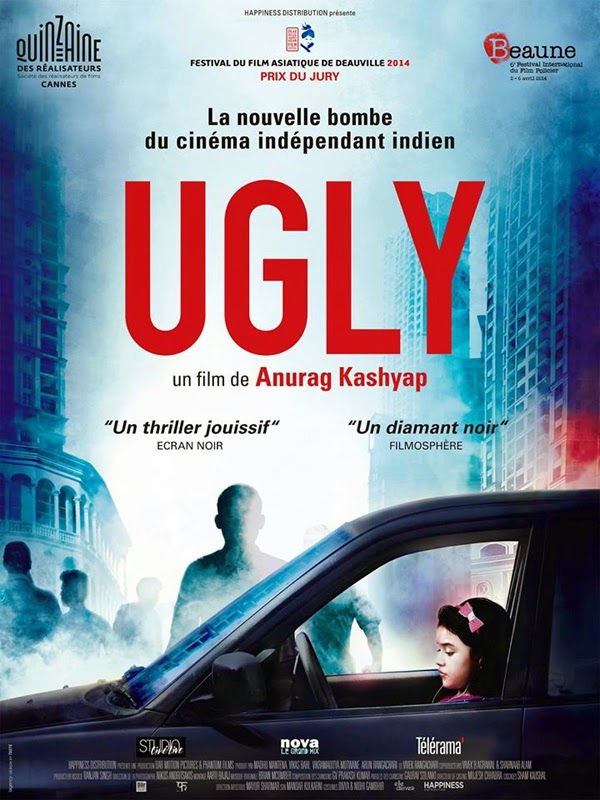
'Ugly' is Beautiful

And yet another year ends. Not such an eventful year but yes, a rather good one. At least nothing bad happened to me. In this world, at such a time when the human behaviour has gone to such a negative level that anything bad can happen to anybody at anytime, I am rather pleased that I was not at the receiving end of any such mishappening. Anyways, this very blogpost is not yet another typical year ender blogpost. This is about Anurag Kashyap's recent release 'Ugly', about the film and about that same negative human behaviour that the film is all about and what I was referring to earlier.

'Ugly' was premiered at last year's Cannes film festival in director's fortnight section and has been making news since then. First for its wonderful response at the premiere and then for the controversy regarding that "smoking is injurious to health" message forced to be put in by the indian censor board, it was always in the news for all sorts of reasons. With the limelight, the wait and anticipation for the movie was also increasing and that's why I couldn't wait for much longer after its release. And after watching the movie, I must admit the wait and anticipation was all worth it. It is simply the best movie that I watched this whole year and also amongst the best that I ever watched.

Ugly on the outset is a story of the kidnapping of a 10 years old girl who is the step-daughter of a top cop of Mumbai police. She was away with her biological father on the routine weekly meeting day (as per divorce settlements) when she was abducted in the broad daylight. The incidents that follow is the whole movie. The police investigation, the trust issues, the betrayals and the greed everything characterises the theme of the movie and at the end the kidnapping comes out to be the side plot of the movie. The movie comes out to be all about the human behaviours, the greed, the distrust and the vengeance.

The movie starts off with a chase sequence wherein the biological father of the girl and his friend are chasing the suspected kidnapper in the streets of movie. Being an Anurag Kashyap fan, you are reminded of the iconic chase sequence from the movie Black Friday. As the scene goes on building upon you and you start to have that feel of Kashyap's film-making, bam, the suspected kidnapper is struck by a running car. His body parts are shattered all over the road and the first indication of the ugliness of the movie is there before you. The scene moves to that of a police station wherein the complaint of the kidnapping is being lodged.

There are many good sequences in the movie but this police station sequence, in the hindsight, appears to be the best of the movie and one of the best noir-sequences of all time. The sequence moves from the hapless father lodging the complaint to him teaching the police officer how to take and save pictures in contacts of his phone. The scene seems to overstay its welcome and looks like it is stretched just too long. You laugh at the irrelevance but then in the end of the movie you are struck by the fact that this very irrelevance is the total theme of the movie. The whole movie seems to be about the suspense of the kidnapping interspersed with too many irrelevant sub-plots. Sometimes even these irrelevant plots would irritate you but then at the end of it all you find out that these irrelevant sub-plots were actually the main plot of the movie.

The love triangle of the campus in the backdrop leading to the revengeful acts in the present, the seduction of the husband's friend just in reply of a casual appreciation of her beauty, the greed for money are all the sub-plots of the story. They seem to be irrelevant but in the end lead to the grotesque climax. These human behaviours lead the police investigation to a total awry path leading to an ugly end of, what in the end seems to be, a shameful story.

Anurag Kashyap is totally back in the form with his dark comedy shot in the filthy dark rooms of the Mumbai suburb. If he has to do the useless cameos in movies like Happy New Year and Bhootnath Returns to earn money to make movies like this, I am all okay with it. The way he has used all the actors is just commendable. Ronit Roy as the cop has come up as the most dependable actor lately. He is still in the 'Udaan' mode and seems too comfortable as a tough cop and a stern authoritative husband. Tejaswini Kolhapure as the alcoholic wife and Rahul Bhat as the struggling actor and the divorced biological father  have done justice to their role. Special mention must be made of two actors. National award winning marathi actor Girish Kulkarni and Vineet Kumar Singh are more than impressive and must be appreciated for making few of the sequences of the movie special. Dialogues are raw reminding you of the dialogues from a Tarantino movie. The background score keeps up with the tone of the movie. All in all, I must say, 'Ugly' is beautiful.

[In the end, a scene from the movie. Just watch out for Girish Kulkarni:]


Sunday, December 9, 2012

Talaash- a search of your beliefs!!!


Waiting for a movie from the time since it first made news about its making is a much usual phenomenon for me when it comes out to be one of Aamir Khan's. And during all this waiting, avoiding every other news, previews, stills, scenes, etc is a completely deliberate act for me. For me, watching a movie without knowing a bit of it and being completely unprepared for whatever is coming on to you in the movie is the best preparation that one can have. Being unbiased about the storyline and everything is the key to a successful outing to a movie. This is something that I practiced for Talaash, the Aamir Khan starrer movie.

There are times (it has become somewhat frequent, these days, with newer breed of film-makers operating) in bollywood when you come out of the movie and you are not sure about how good or bad the movie was. You think over it, you recall the scenes, you relive the movie inside you and then you feel that it has started to grow inside you, and once that growth starts, its real hard to stop it from shaking you from the inside. Talaash is one such experience.

Talaash starts as a murder mystery in the form of a mysterious road accident that kills a leading film-maker drowned in the sea inside his car. The case comes to a police officer of high repute in his circle who starts the investigation and in the way of that meets different people, different situations and different circumstances leading him finally to the end of the mystery, the end that is not quite the end to the mystery only but also comes out to be an end to many of his questions. There is a point in the climax of the movie that it suddenly ceases to be a mystery thriller and becomes a psycho-social drama and the main plot of the murder mystery becomes a side plot of the movie. The best part of the movie to me was this transformation in the climax.

Talaash, is a not a story about the search of an intense, silent police inspector (Aamir Khan) disturbed with his son's death about a mysterious death, being helped in the process by a prostitute (Kareena Kapoor) and being questioned by a grieving mother and lone wife (Rani Mukherjee) for his over-indulgence and a suspected extra-marital affair in that search. It is the story of a father's search about the reality of his self-imposed guilt of being guilty of his own son's death. It is a story of a lone wife's search of her husband that she lost in a tragic accident that occurred to her family. It is a story of a couple coming in terms with their child's death finally and accepting it as an accident that was a fault of none.

The thing that confuses everyone in the end about whether the movie was good or bad is that in the end it leaves your mouths wide-open and minds confused with something that questions your belief system. This twist in the climax, as already said, was best part for me but must be difficult to swallow for many. This is the time when you realise that the plot that you were totally into for the last two hours was only the side plot and all the side plots of the story start to join themselves together one by one and becomes the main plot. This required a strong screenplay and thats what Talaash is all about.

Reema Kagti with her second directorial venture after Honeymoon Travels has lived upto and even crossed her own mark that she earlier set for herself. She, with Zoya Akhtar has provided a strong screenplay to their own story that is totally able to bind you to the seats for the total duration. Ram Sampath's music is more than just audible with a fairly nice lyrical work from Jawed Akhtar.

Aamir Khan as a moustached intense police inspector is once again redefining himself. His lack of smile, sleepless nights, crying with his guilt everything is lovable here. The scene where he is reliving the circumstances of his son's death and the alternatives that he could had done then is just brilliant. Rani Mukherjee with her non-glamourous, saree-clad housewife's role is telling you why she right there in top a few years back. The freckles on her face, the dark circles below her eyes make the theme of the movie totally alive. As one of my friend said that only after coming to Calcuta he actually realised the hidden sex-appeal a bengali woman holds inside her in her desi-looks, Rani Mukherjee with her looks in Talaash reminded us that she was also a bengali, a 'Bong-Bombshell' as we call them!!! Kareena Kapoor has also done total justice to her role and I don't think in present day breeds anybody else could have done it better than her. Nawazuddin Siddiqui is once again brilliant here with his 'bechara' role once again where he is beaten by everybody and in the end dies without doing anything. After Kahaani, Gangs of Wasseypur and Chittagong he has once again pulled back a great performance.

All in all, Talaash is not a great movie, not something that breaks records at the box-office with its glamour. Its a movie that hits you with its lack of glamour and still takes you away with itself into deep thoughts, into deep questions about your beliefs.

Friday, May 25, 2012

To Kill a Mockingbird

Being an Indian and being a movie buff, I have already seen a lot of movies that have been adapted from many other works of art. Mostly they have been (without any reference) taken from a foreign film and hence the use of the word stolen instead of adapted won't be much wrong. However, having said that, there have been quite too many indian movies that have taken a prior work of art as their bases and with due respect and reference too. Movies like Guide (from R.K. Narayan's novel of same name), Devdas and Parineeta (both from Sharat Chandra Chatterjee's novels of same name), Bees Saal Baad (from Sir Arthur Conan Doyle's The Hound Of Baskervilles) and a whole lot of other well known hindi movies are amongst them.
Having said all this about the hindi movies, there have been a whole lot of movies in the foreign language that are based on some literary works. With me not having a habit of reading much, most of these movies (as well as the hindi ones) were seen by me before having read the novel or the story. Contrary to the normal course of action that most people follow, I have always drawn parallels in a novel from the film that is based on that novel. Comparing the novel with the film already seen, observing the differences that the scriptwriter has made in his adaptation, and then quantifying and then balancing the impact left by the novel as well as the movie is what I usually did. The difference from most of the people being the fact that they do this with the novel as their baseline whereas I used to do this as the movie as the baseline. After doing too much of this 'reverse' thing, I finally got to watch a movie that was based on a novel that I already had read. 'To kill a mockingbird.'
The Harper Lee's novel is about the neighbourhood experiences of a young girl from an imaginary city of Maycomb in Alabama. The story deals with the issues like racism and rape and the reaction of the small neighbourhood to these happenings. Despite having such bold issues as the backdrop, the story, having written from the point of view of a young girl, never leaves its tone that for the most time of it is calm.
The girl's father, Atticus Finch, a lawyer, is defending a black man, Tom Robinson, from the allegations of rape of a white lady. The white people of the society are opposing Atticus' this action but he stands firm with his principles and presents to the court of law a case where clearly the alleged is not the convict. The jury, all consisting of white members, still, pronounces Tom as guilty. Surprisingly, no one is surprised. The whites laugh at Atticus for taking a case he knew he was to lose and the balcks applaud Atticus for atleast trying. They all knew the result of the case, the whites, the blacks as well as Atticus Finch except for the young girl and her older brother. They could not understand the jury's decision. They stand by the side of their father all through this and believe in him and hence are shattered when he loses the case and thats how they start to see the ugliness of the society they live in. Despite all this, Atticus, a wonderful father that he is, manages to keep the innocence of the children. He talks to them, tells them the truth about everything, passes on to them his own principles and really lives like friends to them.
The character of Atticus Finch has been one of the most influential characters that has left some impact on its reader. A model for the lawyers for his principles, he has been a model father that every child would like to have and on the other hand, every father would like to become to his children. The novel was first published in 1960 and went on to become the international bestseller and also won the Pulitzer Prize. The movie adaptation was released in 1962 directed by Robert Mulligan having Gregory Peck in the role of Atticus Finch. The movie is an able match to the beauty of the novel and there must be only a few examples where both the novel and the movie adaptation are as wonderful and acclaimed as this one.
Being one of the very first novels that I completed reading, I was much happy with it. And then having got the opportunity to watch the movie so soon after added an extra curve to my smile. And also reading the novel before watching the movie, being a new experience to me, was too wonderful to explain. Surely, this is a practice that I definitely want to acquire in me and hope that I continue reading and then also watching the movies.


Monday, January 24, 2011

Dhobi Ghat (Mumbai diaries)

Its really been a long time since I wrote my last post here. I started this blog with much determination but was totally without any idea of how I was going to be regular on here. There were a few books that I had to read and a few films that I had to watch, and hence with a slight (may be recurrently transient) inclination towards English, I started this blog. I couldn't finish those books through this time and, although, managed to watch those movies, just couldn't get enough time to spare here. Maybe, sometimes, career has to be put ahead of hobby, I suppose. Anyways, with no more boring stuff let me come straight to the point.
Dhobi Ghat, Mumbai Diaries......what was it, story of the city mumbai, story of the four characters, story of the character mumbai, story of their life or just Kiran Rao's experiment with film-making? What it really was? It was nothing, but a simple way of story-telling. The telling of the stories of the four lives, stories which does not start with their start or doesn't end at their ends. It starts from somewhere, at some point in their life and all of a sudden, after almost 95 mins, ends abruptly at some another point in their life downstream.
We in India have been watching movies that take somebody as a central character and then just take us through either the whole life right from its birth to the end or through a special episode in that life. Dhobi Ghat is completely different on this aspect (and, by the way, also on many other aspects). The original notion of bollywood of making films based on characters having quite an eventful life is being challenged here with this very simple, yet very different art form. Most of us, common people, take birth and die, and in between lead just an uneventful life. Dhobi Ghat is just about a small passing by part of such uneventful lives of four characters.
Arun (Aamir Khan) is a painter by profession, a loner by attitude and a question for everybody who comes in contact with him, including the audience. He has serious problems with relationships, is a divorcee, loves to live alone and has no one really to talk or rather doesn't like to talk to anybody. His only acquaintance is Yasmeen (Kriti Malhotra), a small town girl who comes to Mumbai as a newly wed and is busy in exploring Mumbai and making videos for her brother. She is the only one who manages to arouse interest in Arun's lonely head that too through her video tapes that Arun just finds serendipitously.
Shai (Monica Dogra) is a investment banker in America who is on her Sabbatical and is exploring Mumbai just for the sake of her hobby, photography. She manages to have a one-night stand with Arun (who denied any prospect of a long term relationship out of this), and then manages to find Munna (Prateik Babbar), a neighbourhood dhobi and starts exploring Mumbai. Shai sees the different characters of the city with Munna's eyes. Munna is a migrant from Bihar, who has a deep feeling for but is hesitant of any kind of relationship with Shai.
To say that the movie is all about these four characters and their interaction with Mumbai is totally wrong. Its nothing about it. After so many featurette released, so many of interviews of the film-makers watched, one enters the cinema hall with a clear-cut idea in his mind that there is gonna be a completely different experience inside. And yet, one walks out of the theatre dumb-struck. Nothing to think, nothing to say, no opinion, no views. Thats the real beauty of the movie. It manages to keep its "differentness" even after your expectations of differentness is at its highest level.
To say that the movie is completely flawless is totally untrue. The characters of Shai and, even, Munna, are a bit beyond understandings for me although Prateik Babbar as Munna has showed real glimpse of his immense talent in acting. Although, the cinematography is fabulous, editing could have been a lot better. The biggest reason why the movie is not gonna be liked by masses in India is the story of the movie, because there is not any. We, the masses in India, have watched the Johars and the Chopras so much that we only think of their stories to be STORIES although, they attack haplessly on our emotions. For those who keep themselves in 'intellectual' category, the stories of films from recent years who have promised to be different like Udaan or Dasvidaniya are the stories to look for, although, they attack on us emotionally. Dhobi Ghat with its complete novice idea does not attack at all. It, now, might define the 'intellectual' category amongst the movie-goers in India.
Marissa Bronfman writes about the movie and about its premiere at Toranto International Film Festival at The Huffington Post. Excerpts:
"There were no choreographed dance sequences, no lip-synched songs, so while Dhobi Ghat (Mumbai Diaries) may not have been a typical Bollywood blockbuster, it is paving the way for a new era in Indian cinema to emerge without sacrificing it's heart along the way.....At its world premiere in Toronto, Dhobi Ghat showed the world that Indian cinema is no longer stuck making homelessly formulaic films and that the industry is growing up and starting to experiment with different characters and narratives."

Well, all in all, Dhobi Ghat is a wonderful collage of faces on the canvas of life which does not end. It goes on. There are no resolutions in the end, there are no morals too. Just like it starts from somewhere, it ends at somewhere abruptly, maybe because, it has no end, maybe because life has no end. It moves on, it goes on and on and on...

Tuesday, November 9, 2010

Random Movies, Random Thoughts


Most of the foreign language films that I watched recently were, in some way or other, based on the theme of a dysfunctional family. Its not that this was the keyword for my searches on the internet that I got these films. Nor that my search engine was a little biased towards such films. Surfing or rather straying on the internet, reading blogs and going to the different links that one gets there may prove useful sometimes. This is how I got to know about and watched such films that includes Last Tango in Paris(Fr., 1972), Little Children(En., 2006), Ma mère(Fr., 2004) amongst others.
All these films were based upon human emotions arising from a dysfunctional family often leading to the evils of perversions, infidelity, adultery and even to incest. Watching the films left me thinking about all these issues. Paul (Marlon Brando, Last Tango...) mourns the suicide of his wife and strays into a senseless relationship with a young strange girl. Having grieved by his wife's infidelity and then by her death, he tries to give himself the pain. He wants to see his own death in front of his eyes and for that goes even to the limits of sexual perversions. He bangs into a strange girl and urges her to continue the strangeness. Maybe, after one failed marriage, his belief on a family system was over.
Pierre (Louis Garrel, Ma mère) also suffered the agony of a dysfunctional family. After the death of his father, he realises the bitterness of the relationship between his parents. Discovering a pile up of porn magazines from his father's wardrobe and knowing of the amoral character of his mother left him wandering. He then succumbs to the amoral promiscuous ways of his mother and ends up having a incestuous relationship.
Amongst the films that I have mentioned earlier, Little Children left me thinking the most. Four characters, having failed in life once or more, try to win it for themselves. Sarah (Kate Winslet) failed to his husband's perversions towards internet pornography. Brad (Patrick Wilson) had too many problems, the agony of being fed by his earning wife, the annoyance of failing the law exams twice, the irritation of  not being able to continue his college-days legacy in sports and the frustration of not being successful at all in life. Larry (Noah Emmerich) lives with a guilt of killing a child unknowingly. Then you have Ronnie McGorvey (Jackie Earle Haley) who has to live with a lifelong curse of being a pervert. All the characters with their own share of problems tend to do something to prove their identity. Sarah choses to get closer to the 'prom king' (Brad) to prove herself in front of other ladies from the suburban neighborhood ultimately going to the limits of having an adulterous relationship with him and planning to flee away with him. Brad sees in this relationship an identity for himself that he lost to his earning wife. He wants to be recognised by the skateboarders en route to his law classes. Larry wants to do something for the children of the locality and in that sees Ronnie, the pedophile, a big social problem and launches a movement against him. The psychosexually ill Ronnie wants to improve himself but nobody allows him to do so. When he is ousted from a public swimming pool for his past deeds, he shouts that he just wanted to chill out, but the society doesn't let him to.
At the end, everybody gets the better of him/herself. Sarah, watching the Ronnie's grief of losing his mother, realises that the real happiness lies with her family. Brad, on way to Sarah, is recognised and given a chance to skate by the skateboarders, in the process getting injured and ending up at the hospital, realises the love of his wife. Larry, causing the death of Ronnie's mother, realises the guilt and helps Ronnie with his life. Ronnie, to prove himself, ultimatly castrates himself and in the process makes Sarah and Larry realise their own guilts.
The movie was about human emotions, hope and despair, the elements that make in themselves the whole idea of human civilisation. We wake up in the morning with a hope of making better the day ahead. As the day progresses, the despair of this hope not being fulfilled fills us. Then we hope again and despair follows. The emotions attached with these hopes and despair can take us to all bounds. We may succumb to them as the characters of these films or we can come out fighting with them and ultimately getting victorious. The cycle of this hope and despair continues in our life and often signifies the very idea of being a human being. The motivation for moving ahead comes from these despair and the courage to execute these motivations comes from these hopes.
       

Wednesday, November 3, 2010

A moronic article from The Times of India editorial!

Sitting idly at work for 4 hours without doing anything may be a regular affair for the primary school teachers of govt schools in Bihar, but the same for people like me, who likes to be busy with work, is nothing less than a punishment. A total of 10 patients for 7 people at duty was all that we got today. With so less of work and medical books opened in front of me, it was getting harder and harder for me to keep my eyes open. This was the time when I fetched for today's newspaper and got to read this article from the editorial segment of The Times of India.
The article was about Metro-Goldwyn-Mayer filing for bankruptcy. Reading the first lines itself left me shocked and surprised. The roaring lion face surrounded by the filmstrip came before my eyes just by the mention of MGM's name. Some of the Hollywood's classics have come from this production company and thinking of all those films, I was not feeling comfortable with the news of it filing for bankruptcy.
The article also compared the Hollywood's style of functioning to the Bollywood and at many places indicated that Bollywood can be better than Hollywood. The title of the article itself contained a footnote saying, 'Days of Hollywood’s unquestioned supremacy may be over'. The article was in the editorial segment of the newspaper wherein the writer's name was not specified but whosoever he/she was must be a moronic follower of Johar/Chopra's Bollywood. Where the start of the article left me disheartened, at the end the feeling was completely different. Inspite of thinking of MGM's bankruptcy, I was, more of, laughing at the wits of this writer.
To quote him,
Metro-Goldwyn-Mayer, the legendary 86-year-old Hollywood studio, is filing for bankruptcy. This relates to Hollywood’s style of functioning, marred by overblown budgets, unreal plots, unsure narratives and tired stars, none of which enthuse audiences that are themselves changing and seeking novelty mixed with realism. In contrast stands Bollywood, the Hindi film industry steadily expanding over the globe. Bollywood’s themes are constantly energised by everyday culture and mythology while increasingly including edgy, experimental stories.  
 The writer says that the Hollywood is suffering its overdependance on overblown budgets or unreal plots or tired stars and that the Bollywood is gaining global expansion due to its edgy, experimental themes. If that is the actual matter then how exactly the overblown budget of Raavan, or the unreal plot of Veer or the tired stars like Shahrukh or Salman are leading Bollywood to a global acclaim is completely beyond my understandings. Every second film in India is said to be a remake of some Hollywood movie and then this writer is expecting Bollywood standing side by side to Hollywood. Doesn't it all seem hilarious on his part!
The most hilariously absurd part of the article was yet to come in the last line. After all the optimism this was the punch line of the article, an unattainable height of optimism:
It is quite possible that Bollywood could teach America a trick or two about making hit movies, cleverly-budgeted, yet straight from the heart.
 For me these are these 'straight from heart' movies in India, that have never allowed the Bollywood to develop a well respected place in the art world globally. Some movies have come big hits in the world market but who are the viewers there. The reach of Indian people to each and every corner of the world is only what has made such films hit. For international viewers, Hindi films are still way down in priority list. Everyone in India considers Sholay a cult classic, this is what a review in Chicago reader has to say about it:
The tone alternates between slapstick and melodrama, and Sippy occasionally sneaks in some populist messages. The plot is formulaic, the camerawork is slapdash, the male bonding borders on camp.
This is what the whole understanding of Bollywood in the western world still is. And still, if someone thinks that a 'straight from the heart' movie can overtake Hollywood's supremacy, then I have no words for that moron. These 'straight from the heart' movies have only managed to make the viewers cry. The Johar/Chopra's or Shahrukh's blind supporters are not the only one who cry their hearts out while watching such movies. There are some other people also who cry albeit the reason is a bit different. The first group pf people cry as they succumb to film maker's desperate act to make people cry and the other group cries on that very desperate act. I don't know till when these people will continue to give such shits of melodramas but I am completely sure that till then Bollywood can never become a stronger force in international cine-world.