Thursday, September 3, 2015

Aarushi: Why one must read it


Last few days have seen an interesting murder case managing to gain a lot of headlines. Any of the news medium that one choses to follow, be it the print media, electronic media or web world, one would come across this high profile Sheena Bora murder case. The Times of India group along with its TV partner Times Now seem to have taken up this case as their moral obligation to bring the accused to justice. And in order to do so, they have been coming up with several stories, each adding multiple twists to an already twisted story. Days after days, TOI is dedicating full pages to this story with several senior journalists giving their opinions on the case and the people concerned. A kind of a media trial is on the way and soon, it appears, the murderers would be sentenced on live TV debates on the prime time.

All of this has brought back the memories of another high profile murder case involving some not-so-high profile people that occurred a few years back in Noida. The Aarushi Talwar murder case was the first instance when I saw a media trial. The twists and the turns involved in the case and the hoopla created in the media made it impossible for anybody to just ignore that. The case generated interest from the very first days of its investigation which rose to its peak with the CBI filing the closure report and again re-opening the case with the Talwar parents being accused of the murder that too after the Talwars, themselves, had filed petition against the closure report. The trial ended in the conviction of the accused leaving behind many in doubts about the final decision of the court.

Recently, Avirook Sen, a journalist who covered the story for the Mumbai Mirror, has come up with a book on the particular case named Aarushi. The interest that the case generated at that time compounded with the lingering doubts on the court's verdict didn't leave much option but to have a go at the book. I went into reading the book with a preemptive opinion on the case wherein I, somehow, agreed to the court's verdict. A week or so later, when I came out having finished the book, I must say, I have serious doubts now on the trial judge's decision.

To analyse Avirook Sen's Aarushi, one first should remember the fact that there are two aspects to be reviewed in it. The first one is the legal aspect of the case that CBI put up in the Ghaziabad trial court along with the way the police investigated the dual murders or the concerned people tried to manage the post-mortem reports and witnesses changing their statements etc. The second aspect is to review the book on its literary content, whether the author does a justice to that and whether he managed to remain impartial through the course of the book. The media handling of the story can be the third aspect to be reviewed as far as the case is concerned but for the sake of the book, lets focus on the first two only. 

As far as the first aspect is concerned, there is nothing much new to write. Already many points have been raised that invoke serious doubts in the verdict. There is no doubt that the UP police did huge mistakes from the very first days of the investigations. Probably, they got serious after media showed such huge interest in the case but it was already too late till then. The absurd press conferences of the local police with the absurds theories to explain the murders not only managed to draw attention of the media towards the case but also caused serious damages to the characters of the Talwar couple that was there never to be restored as we saw later in the course.

The case was rightly transferred to the CBI but their handling of the case remained suspicious too. Changing the investigating officer midway in his investigations raise a few doubts especially when he is replaced by somebody who is known for his love of the hook-or-crook methods to solve any case. The first part of the investigation moves in a direction where the house-helps are the suspected perpetrators of the crime but it suddenly changes on its head when in the later part of CBI investigation the parents are the accused. 

However, CBI filed a closure report failing to gather enough evidence in order to grill anybody concretely. The parents filed petition against the filing of closure report demanding further investigations and the closure report is suddenly changed into a charge sheet in which the parents are made the accused and a trial is started. The trial in itself had several points that raise several doubts regarding the affirmity of the final verdict. Some of the instances being witnesses changing their statements, typographical errors on the evidence labels, post-mortem doctor himself changing statements a several times through the full course of the case and then a witness repeating again and again in the court on being questioned, "Jo mujhe samjhaya gaya hain, wahi bayan mai yahan de rahi hoon. (Whatever was taught/explained to me, I am testifying here)."

All in all, these all points raise enough doubt in the conviction of the accused. As the basic tenet of our criminal law goes, it is better to have a hundred guilty go unpunished than punishing one innocent person. In this very case, I think now, that there are several points that raise enough doubt on the Talwars being guilty of the crime and hence they were entitled for that benefit of doubt that our law has provisions for. Plus, the onus of proof lies on the prosecution and the defence needs not to do anything if prosecution fails to prove its case conclusively. In this particular case, it seems the onus was left on the defence to prove their innocence and in lack of such concrete evidences, the final verdict came against them. The book manages to raise all these important questions clearly and hence, manages to influence the reader with some concrete facts concerned with the case. Sen has done full justice as far as the legal aspect of the case is concerned.

As far as the second aspect, the literary content of the book, is concerned, Sevanti Ninan in her article about the book on her website rightly says, "Reporters in this country should write more books.They nail the system quite devastatingly when they piece together their notes after the story has run its course." The book raises a very important question on the journalism that we see in our country. The attrition rate of stories in our news media is so high that even the viewers/readers tend to forget the stories quickly. The most concerning point is a lack of follow-up of the cases by our journalists. This book is a beautiful example of how a story is followed-up even after the interest attached to the story has completely faded down.

As far as his being impartial as an author is concerned, I think Sen fails somewhat on this front. From the very first page, it seems that he has written the whole book in order to prove that the Talwars are innocent. Knowing the whole story completely himself must have made it real difficult for him not to have that preemptive opinion but then writing the book meant putting and analysing all the facts wholly and impartially. It seemed that he gave a lot of importance on how corrupt the practices of that CBI investigating officer (Kaul) were who changed the case upside down and made the parents the accused but the character of that CBI investigator (Kumar) who suspected the servants to be the murderer were put into the books just as passing remarks. Much importance was given (in fact more than few pages were dedicated) to Kaul's management of the witnesses in the cases he was involved in the past but not much importance was shown to the fact that even Kumar was found to have letting loose the rich influential people in his earlier assignments. Similarly, a lot of importance was given to what Nupur Talwar felt of Kaul but again Kaul's thoughts about Nupur were mentioned as passing remarks only.

"He would later tell Nupur that he had a bad feeling about Kaul. She told me, ‘I also felt it, in fact we talked about it. I said why is he giving us these dirty looks? He asked, what kind of bed sheet did Aarushi use? I said blue bed sheet with a Disney print on it . . . He gave me a look as if I was lying. I said ya, that is what she was using. I knew there was something wrong, immediately.’ That first meeting would define not just the relationship that Kaul and his team would have with the Talwars, but also the line of investigation. Kaul, like so many other people, may have got the impression that Nupur Talwar was cold and manipulative—and a little too assertive for his liking."
Sen questions the court proceedings also at some points. At one such instance, he questions, "prosecution never gave any indication as to which witness would appear at the next hearing and then be expected to cross-examine them the day they appeared." But nowhere does he mention whether it was according to the court proceedings or special exceptions were made for this case only. The epilogue of the book with Rajesh Talwar's diary seems to be an attempt at gathering sympathies for the Talwars. But then we must remember, there are always two sides of a story.

Who is the real murderer is a question that can be answered correctly either by the murderers themselves or the ones who where murdered. The prosecution and the defence, both, have their own sets of stories that explain the murders. Avirook Sen with his book appears to put forth the defence side of the story. A fabulously written story with complete facts is what this book is all about. He succeeds in putting forth all the points concerned from the defence point of view. Sadly, Mr. Kaul the CBI investigating officer is no more with us and we would never get a book from the prosecution point of view but what an interesting idea that would have been.

In the last, a passing remark on this article that I stumbled upon most recently relating to the book, its completely your loss if you don't chose to read the book just based on something immaterial that occurred in a panel discussion on the book. Do read this book. It would certainly force you to question the ways police handle different crime investigations and the level of forensic practices that we follow in our country. Seriously, a lot needs to be done on these aspects.


Tuesday, July 21, 2015

Tanu weds Manu Returns, an overhyped-overrated film

There are certain movies that you don't want to watch only because you made your mind that way in advance for some very unrelated reasons. Tanu weds Manu Returns (TWMR) was one such movie for me. Lately, I have been appalled by the idea of feminism that Indian main stream entertainment community is promoting of late. It all probably started a long ago and I don't actually seem to remember the exact point where it all began. But surely this vogue video of women empowerment featuring Deepika Padukone took this feeling of disgust of mine towards feminism to its peak. Not wanting to watch TWMR was one reaction that came to me with that same disgust that I referred to in the previous line. It was publicised and promoted and then reviewed as something that has a strong female character and that defines the feministic revolution in India. However, due to unknown reasons to me myself, I finally chose to watch the movie, just in case...

Having seen the first instalment of the franchise, it was much easier for me to relate to the characters and the concept. The movie starts off where it ends in the first part. Tanu is marrying Manu with Lata Mangeshkar's Sun Saahiba Sun playing in the background. The unusual couple that Tanu and Manu would make was quite evident in the exactly opposite personalities portrayed by their characters in the movie. And when the movie shifts to a chilling day in the countryside outside London four years later, it was clear enough that the inevitable has broken loose. One just gets the feeling that four years were way too many for this couple to have realised what they were telling their mental rehabilitation counsellor there. And its there where my problems with the movie starts. Why a mental rehabilitation centre? Why not a marriage counsellor! Well, maybe because Manu alleged Tanu to have a bipolar disorder they went to a mental rehabilitation centre but then the way the sequence culminated was bizarre. It didn't make even a little sense in sending Manu to the asylum and cutting loose a moronic alcoholic that Tanu is. There are some beautiful dialogues in the sequence and some over-perfect analogies that crack you up but then it was very clear that who actually was the problem in the marriage. Anyways, lets move further..

Tanu moves to India to her hometown Kanpur and informs Manu's friend Pappi (Deepak Dobriyal) and his family about his being in the asylum. Pappi reaches London and instead of getting his friend-brother out of the asylum chooses to roam about in London only because he had spent a lot of money to have come there (The money, by the way, in all probability, were Manu's father's). A charming, humourous character that Pappi was in the first movie comes in his very first scene in this one as a forced comedian and continues that way through the whole length of the movie. His witty one-liners and the presence of mind in the first movie have been reduced to repetitive, irritating gibes. A real waste of the talent.

Manu, a cardiologist, also is brought back to India and is delivering a lecture on cardio-vascualr diseases at the Biology department of the Delhi University. He happens to speak on a heart condition called arrythmia. He says that there are two kinds, Bicardia and Tricardia. He also goes on to define the two conditions and then I realised what he wanted to say was Bradycardia and Tachycardia respectively. Such a level of ignorance on the part of the director or the dialogue writer was not expected by me. To have made a whole movie with such little research on the subject, I think, is unpardonable. I lost all the interest in the movie then and there only but managed to come back and continue from there on just for the sake of it.

During that same lecture, Manu happens to have a glance at a haryanvi female athlete from the university who is a doppleganger to Tanu. Having a desire to live with Tanu for his extreme love towards her and having his realisation after the four years of marriage of the fact that he can't, he falls for Datto (Kangana 2.0). Meanwhile, Tanu is in her self mode of a careless girl that she was in the first movie. Taking the help of one typical 'Bhaiyaji from UP', a law student-turned-lawyer (Zeeshan Ayyub), she starts meeting her ex boyfriends and finally meet the real bhaiyya ji of the first movie, Raja Awasthi (Jimmy Shergill). There are some good sequences involving Shergill and Ayyub in the typical bhaiya-tone of the goon-land of UP. Shergill is as good as he was in the first movie and Zeeshan Ayyub manages to impress till comes the climax.

The movie starts to descend from here. Tanu gets to know about Manu's marriage to Datto and then feels victimised and wronged on the hands of Manu. Too many characters, concepts and sequences have been forced to move a movie that is going nowhere from there. The Bihari friend of Tanu's (Swara Bhaskar) comes in with her own problems of giving birth to a child through artificial insemination and not telling her husband about it. Pappi's one-sided affair with a punjabi girl that ends into a sort-of-kidnapping of the girl by him with the help of Manu and Datto. A garba-bhangra mix in a punjabi household. And a khap panchayat types scene in the haryanvi village of Datto's. All these sequences and the characters therein create a khichdi that starts as a confusion and goes on to become unpalatable and extremely painful for your heads.

The real problem starts with the victimisation of the character of Tanu. It was all OK when she was flirting with the english guys during her marriage in London and then roaming around the streets of Kanpur with her lawyer friend to see and meet all her ex-boyfriends. The moment she comes to know about her husband's second marriage, the feminism in her starts boiling and she ends up saying, "Hum thode bewafaa kya hue, aap badchalan ho gaye", where in reality it is she who is both bewafaa and badchalan at the same time. It was beyond my understanding, the way she was presented in the movie as someone who is facing the falsehood when in reality, she herself is the one who is false here. Geeta Dutt comes in with the background song Ja Ja Ja Bewafa. The soulful song picturised on Tanu with a bottle of whiskey in her hand roaming on road in a lonely night promises to be a great scene but with the backdrop of the story of TWMR, the whole sequence becomes meaningless. So is the referral to Pakeezah, with Tanu dancing in Manu's marriage.

The sequence leading to the second marriage reveals Tanu realising her love for Manu and her stubbornness to be the part of that marriage. Everybody starts to root for her and her pathetic condition is visible to every-single-body. It goes beyond senses for me that these people couldn't see what she managed to do with her husband during her marriage. A seriously loving and caring person, Datto, has to pay the price and sacrifices her love for someone who doesn't even know what its all about being married and being a loveable couple. The movie ends with Tanu reconciling with Manu and that's where the whole idea of TWMR comes out to be flawed and the viewer comes out to be cheated. It teaches you that you don't need to push hard enough to be in a marriage happily and you can roam around your exes and still your husband will take you back whole-heartedly, beacuase afterall Its her choice!


A passing remark for the director. He didn't even care to work that much hard on his characters that a mole on the neck of Datto's character continue to come and go through the whole length of the movie. Such lazy piece of crap that's not well researched is what the director Anand L Rai has managed to get away with. Sad!

Thursday, June 4, 2015

The Possessed...

There have been too many posts on my blog about starting some novel and then not going on to finish them. Well, this one is about starting something. A novel by Fyodor Dostoevsky, The Possessed. The english translations have come in different names such as Devils, Demons etc. I got a hand at the oldest translation of the russian story, the one by Constance Garnett in 1916.

This is not the first time that I have put my hands on Dostoevsky. Ever since, I was told of him by my elder brother and in a way recommended by him, I never left an opportunity to get a possession of his novels whenever and wherever it was available. Crime and Punishment and The House of Dead are with me for long times but still unread. The first time I read Dostoevsky was his short story White Nights. The movie Saawariya was based on the story. I was told about this fact by my brother who also asked me to go through the story. I must admit, it was a great experience.

Since then, Dostoevsky's persona has intrigued me. I've got to read few articles on him and all of them have posed so different an identity for him that it has really been difficult for me to create a clear idea in my mind as to what he actually was. It is simply not possible to characterise a varied talent such as him by reading just one of his short stories. Maybe, in future, when I have read a few more of him, I would be able to have a better idea about him.

Lately, as I already told, I have started The Possessed. It is a long novel and hence, for a person like me who is so irregular with reading, I don't know whether I would be able to finish this one. Still in the very early parts of the book where still the character building is going on, there have been some instances where in one can have an idea of the author's opinion on issues like nationalism, rebellion etc. One such instance of his opinion on nationalism is being shared here. An excerpt...

“...It all springs from the charming, cultured, whimsical idleness of our gentry! I'm ready to repeat it for thirty thousand years. We don't know how to live by our own labour. And as for the fuss they're making now about the 'dawn' of some sort of public opinion, has it so suddenly dropped from heaven without any warning? How is it they don't understand that before we can have an opinion of our own we must have work, our own work, our own initiative in things, our own experience. Nothing is to be gained for nothing. If we work we shall have an opinion of our own. But as we never shall work, our opinions will be formed for us by those who have hitherto done the work instead of us,...
...For the last twenty years I've been sounding the alarm, and the summons to work. I've given up my life to that appeal, and, in my folly I put faith in it. Now I have lost faith in it, but I sound the alarm still, and shall sound it to the tomb. I will pull at the bell-ropes until they toll for my own requiem!...”
These lines written for Russia in the 18th century still hold true for any other country in the modern world. Everybody is running behind someone with some ideas. So what they are unrealistic and only rhetorical, everybody just celebrate the ideas. Nobody is ever going to perform their part of the duties and think that everything will come to them served in the platters. They tend to forget that the ideas will remain only ideas till someone starts to work on them. It is not the ideas that are important but the thought of the hard labour that should go behind the execution of ideas is what makes the difference. Nothing is to be gained for nothing.


Saturday, April 25, 2015

Two videos, the truth of common man!

In the midst of the preparation of one of the toughest examinations of my career so far, in search of some break from the long study hours, I happened to stumble upon two videos yesterday. Both of them are clippings from news bulletins of different channels. And sadly, this is the only similarity between the two videos. Apart from it, they are both completely different.

This first video imparted in me a riot of laughter so hard that I think I have not laughed so much in recent times. At the same time, I must confess, when I look back onto it, it fills in me an anger so brutal that I just can't explain in words. I have never been a fan of the party he belongs to or, for that matter, of the man himself. Rather, as far as this fellow is concerned, I had always had a sense of despisal for him right from the time when he was a practicing journalist on television. I don't have any strong reason for this feeling but still, I never had no respect for him and this incident in the video has affirmed my feelings of hatred for him more strongly.


And then there is this second video. It comes from one of my favourite programmes on any TV news channel. Another story of the emotions, the emotions of a real common man, the asli aam aadmi. This story leaves me disturbed and thinking. I would be lying if I say that I didn't feel like losing tears while watching the video. Watch for the first 14 minutes of the video piece and try for yourself. I am sure you will feel for it too.


Wednesday, December 31, 2014

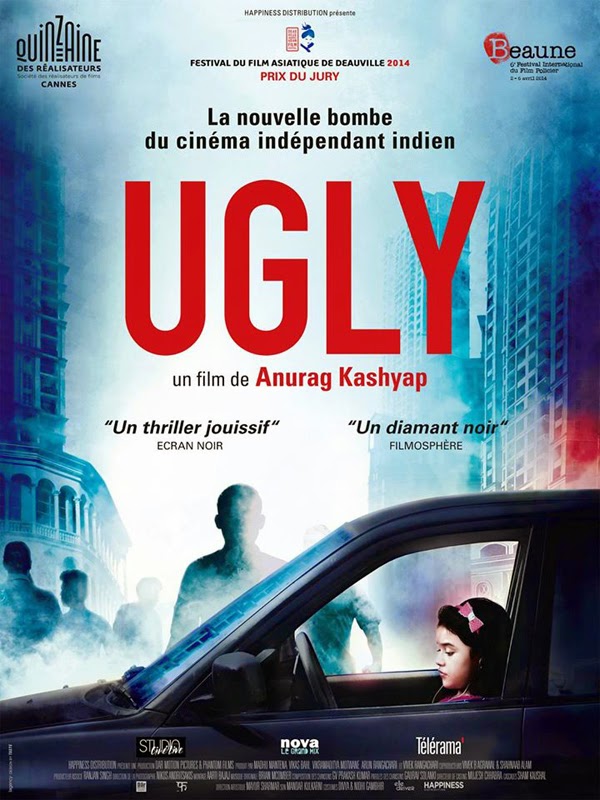
'Ugly' is Beautiful

And yet another year ends. Not such an eventful year but yes, a rather good one. At least nothing bad happened to me. In this world, at such a time when the human behaviour has gone to such a negative level that anything bad can happen to anybody at anytime, I am rather pleased that I was not at the receiving end of any such mishappening. Anyways, this very blogpost is not yet another typical year ender blogpost. This is about Anurag Kashyap's recent release 'Ugly', about the film and about that same negative human behaviour that the film is all about and what I was referring to earlier.

'Ugly' was premiered at last year's Cannes film festival in director's fortnight section and has been making news since then. First for its wonderful response at the premiere and then for the controversy regarding that "smoking is injurious to health" message forced to be put in by the indian censor board, it was always in the news for all sorts of reasons. With the limelight, the wait and anticipation for the movie was also increasing and that's why I couldn't wait for much longer after its release. And after watching the movie, I must admit the wait and anticipation was all worth it. It is simply the best movie that I watched this whole year and also amongst the best that I ever watched.

Ugly on the outset is a story of the kidnapping of a 10 years old girl who is the step-daughter of a top cop of Mumbai police. She was away with her biological father on the routine weekly meeting day (as per divorce settlements) when she was abducted in the broad daylight. The incidents that follow is the whole movie. The police investigation, the trust issues, the betrayals and the greed everything characterises the theme of the movie and at the end the kidnapping comes out to be the side plot of the movie. The movie comes out to be all about the human behaviours, the greed, the distrust and the vengeance.

The movie starts off with a chase sequence wherein the biological father of the girl and his friend are chasing the suspected kidnapper in the streets of movie. Being an Anurag Kashyap fan, you are reminded of the iconic chase sequence from the movie Black Friday. As the scene goes on building upon you and you start to have that feel of Kashyap's film-making, bam, the suspected kidnapper is struck by a running car. His body parts are shattered all over the road and the first indication of the ugliness of the movie is there before you. The scene moves to that of a police station wherein the complaint of the kidnapping is being lodged.

There are many good sequences in the movie but this police station sequence, in the hindsight, appears to be the best of the movie and one of the best noir-sequences of all time. The sequence moves from the hapless father lodging the complaint to him teaching the police officer how to take and save pictures in contacts of his phone. The scene seems to overstay its welcome and looks like it is stretched just too long. You laugh at the irrelevance but then in the end of the movie you are struck by the fact that this very irrelevance is the total theme of the movie. The whole movie seems to be about the suspense of the kidnapping interspersed with too many irrelevant sub-plots. Sometimes even these irrelevant plots would irritate you but then at the end of it all you find out that these irrelevant sub-plots were actually the main plot of the movie.

The love triangle of the campus in the backdrop leading to the revengeful acts in the present, the seduction of the husband's friend just in reply of a casual appreciation of her beauty, the greed for money are all the sub-plots of the story. They seem to be irrelevant but in the end lead to the grotesque climax. These human behaviours lead the police investigation to a total awry path leading to an ugly end of, what in the end seems to be, a shameful story.

Anurag Kashyap is totally back in the form with his dark comedy shot in the filthy dark rooms of the Mumbai suburb. If he has to do the useless cameos in movies like Happy New Year and Bhootnath Returns to earn money to make movies like this, I am all okay with it. The way he has used all the actors is just commendable. Ronit Roy as the cop has come up as the most dependable actor lately. He is still in the 'Udaan' mode and seems too comfortable as a tough cop and a stern authoritative husband. Tejaswini Kolhapure as the alcoholic wife and Rahul Bhat as the struggling actor and the divorced biological father  have done justice to their role. Special mention must be made of two actors. National award winning marathi actor Girish Kulkarni and Vineet Kumar Singh are more than impressive and must be appreciated for making few of the sequences of the movie special. Dialogues are raw reminding you of the dialogues from a Tarantino movie. The background score keeps up with the tone of the movie. All in all, I must say, 'Ugly' is beautiful.

[In the end, a scene from the movie. Just watch out for Girish Kulkarni:]


Wednesday, May 14, 2014

A Tale of Two Cities

The recent surge rather resurge of my enthusiasm towards literature has led me to finish yet another novel. This one is a classic from Charles Dickens, written in the middle of the nineteenth century (1859 to be precise) about a period somewhere six or seven decades further earlier. A Tale of Two Cities, at the outset is a story of the French Revolution (at least as told in my ebook copy that I got from the internet). Searching on the internet for something to read (that too for free) led me to this book, the author of which I had heard something about. In our school textbooks there were some of his stories in the curriculum to be read, Christmas Carol being the one that I still remember.

Due only to the familiarity with the name of the author, I started reading the novel. I had only the slightest of the ideas about the context of the storyline that I got from the small description of the novel at the site from where I downloaded it. I searched about the book on the internet and categorically avoided the plot of the story. The ideas that I started the novel with included the fact that it was a story of comparison of lives and times in the two cities, namely London and Paris in a period just before and during the French Revolution and that it was written by Dickens as weekly instalments to promote the sale of his magazine 'All The Year Around'.

The very first lines of the novel give you the idea about the comparison of the state of the two cities at that time. The differences as contrasting as they were and the similarities between the two cities as parallel as they were were quite evident in the opening lines of the novel. A thorough search about the novel that followed my finishing it revealed to me that these opening lines written more than one and a half century back are one of the most popular lines ever written in english literature.
"...It was the best of times, it was the worst of times, it was the age of wisdom, it was the age of foolishness, it was the epoch of belief, it was the epoch of incredulity, it was the season of light, it was the season of darkness, it was the spring of hope, it was the winter of despair, we had everything before us, we had nothing before us, we were all going direct to the heaven, we were all going direct the other way...  
...There were a king with large jaw and a queen with a plain face, on the throne of England; there were a king with large jaw and a queen with a plain face, on the throne of France. In both countries it was clearer than crystal to the lords of the State preserves of loaves and fishes, that things in general were settled for ever..."
The description of the differences very well explain the tortured condition that the people of France were living in. The way Dickens has drawn similarity in between the two places here must only be his foreseen warning of the fact that if aristocracy is continued in the same manner, even England one day could fall to a similar revolution of sorts.

The whole plot of the story can be found here. The story moves slowly and steadily from being one of comparison between the two cities to one filled with humanly emotions of love, sacrifice, sufferings, life and death. The first half of the story is spent in building up the whole melodrama that the latter half is all about. The extensive build-up of the first half sometimes feel boring and one tends to loose connection with the book altogether.

There were a few times in my reading the novel when I seriously wanted to just put it way. The sheer number of novels that I have kept unfinished became my biggest motivation to finish this one off and I must be thankful that I finally managed to finish it and experience the melodrama that Dickens has put in the climax of the story. Altogether, it is really tough for an early bird like me to comment something on an age-old classic like this one. I must admit, the way the climax of the story has managed to amaze me, it was out of proportions from what I had expected while reading the earlier half of the novel. Must recommend it to those who can have the patience to tolerate the somewhat trivial first half to enjoy the more than exciting climax.

Thursday, April 3, 2014

The Unfinished Ones...

“...I had one last chance to make a decision. One final opportunity to decide who I was going to be. I could step into that alley, stand up for Hassan--the way he’d stood up for me all those times in the past--and accept whatever would happen to me. Or I could run. 
In the end, I ran...”
Well, there have been times, in fact too many of them, in my life when I have strived hard to be a reader. A simple reader. Hearing something about some novel or biography or anything has always managed to intrigue me with trying my hand at reading it. Some of my earlier posts on this blog have been on my time-outs with certain books some that I started and a few that I managed to finish.

To go on with a book to the level where it actually finishes has always been difficult for me. Lack of concentration towards reading can not be blamed for this in any way. Being in a profession wherein you are a student for life, you just can't have that lack of concentration. But then yes, reading and studying are totally different things altogether.

Anyways, there has been many a books that I have started in the past and left them without ever finishing them. I remember Kazuo Ishiguro's The Remains of the Day. I probably started reading that book somewhere in 2001 and then I had to restart it a whole lot of times before somewhere in 2009 that I finally managed to complete it. There were a few books that I started and completed too but recently, over a couple of years, again that same string of starting and then leaving a book unfinished is  continuing with me as if it was a curse.

I remember, I started them all, Dickens' Great Expectations, Dostoyevsky's The House of the Dead, Wilde's The Picture of Dorian Gray, Mario Puzo's The Family amongst others. The Family is still placed in front of me on my table but all of them have been left unfinished. I just don't know where did I lose them. Anyways, even after all these unfinished books all in front of me, I have been starting new ones. There is the hope that they won't end-up like these and then there is the fear of the contrary.

Siddharth Mukherjee's The Emperor of all Maladies: A biography of Cancer and Khaled Hosseini's The Kite Runner are the recent addition to the ever increasing list of my tried books. Incidentally, this time both these books have managed to mesmerise me in some way or the other. Hopefully, both these books will not remain in that same expanding list of my tried books but will find an entry into a somewhat constant list of my finished books.

I am really close to finishing The Kite Runner. I am totally mesmerised by the way this beautiful yet grotesque story has been written. The way it leads you to feeling really bad about the protagonist and the way the story unfolds and leads you to the lively scenes of a politically unstable and socially robbed Afghanistan is simply awesome. More on the story and my thoughts about the book, I will try to put in my next post once I finish the book. Till then, another excerpt from the book giving the vivid details of the street of Kabul that must have been present there in the tougher times.

“...RUBBLE AND BEGGARS. Everywhere I looked, that was what I saw. I remembered beggars in the old days too--Baba always carried an extra handful of Afghani bills in his pocket just for them; I’d never seen him deny a peddler. Now, though, they squatted at every street corner, dressed in shredded burlap rags, mud-caked hands held out for a coin. And the beggars were mostly children now, thin and grim-faced, some no older than five or six. They sat in the laps of their burqa-clad mothers alongside gutters at busy street corners and chanted “Bakhshesh, bakhshesh!” And something else, something I hadn’t noticed right away: Hardly any of them sat with an adult male--the wars had made fathers a rare commodity in Afghanistan....”

Tuesday, January 21, 2014

AAP, Kejriwal and Media Sensationalisation

The new smart-phone and internet era has really changed the world tremendously. Sitting in my hostel room, most of my time is spent either in front of my laptop surfing on the internet or on my phone replying to those messages on whatsapp or looking at the twitter notifications therein. (For my family members who still are bothered about my studies, I must make it clear that this time that I just talked about is exclusive of what I spend with my books.) When at home, thanks to the limited availability of internet, passing time on the television remains my favourite. Writing blog used to be one of the better pass-times that I ever had but due to some reasons or the other, it was discontinued. I wasted a whole post (in my hindi blog) on why I am not regular on my blogs and hence, am not going to bore myself with same thought again.

Surfing the internet or following the twitter trends, recently, I have been brought much into the current affairs. I was never a big fan of current affairs, especially, politics. I already started hating the news channels some 5 years back or even more due to their repetitive sensationalisation of issues and the ongoing race for TRPs. Since the time the news channels have started following the trends in TRP, I think the decline in their credibility has started and till date has reached at a level from where the return back is not possible at all. Be it a real important news or just the trend of TRP, each and every forum of news distribution is following only one thing these days, Aam Aadmi Party (AAP) and Arvind Kejriwal. (I purposely left the 'Mr.' before his name as I thought it might bring him into that VIP list that he has always had aversions with.) 

As I am writing this post here, Kejriwal and his AAP is busy on the streets of Delhi with his dharna and the news channels are even more busy capturing it with all the angles possible. There are reports going on, interviews running, panel discussions on roll, articles flowing, and everything else that can be shown or written is being done. All of a sudden AAP is the rage of the nation, a new voice, a new face. Only time will tell that the dharna going on in Delhi is a real political breakthrough or just a gimmickry of some self-righteous people. Whatever it comes out to be, it is too very clear that it is a result of that same over-sensationalisation of issues and facts that I blamed the news channels for. Just would want to put one question here. Would this chaos that is going on in the streets of Delhi had the same magnitude had the news channels opted for a simple news-telling rather than the over sensationalisation?

Last month when I was at home in my vacation, AAP had secured the historic victory in Delhi assembly polls. I had some arguments with my cousins on AAP's impractical promises and about my skepticism regarding the ability of this bunch of newly elected legislatures. My cousin sister named my skepticism, my cynicism. Looking at the chaos that these people are creating in Delhi, I think my doubts are now transforming into my beliefs. I doubted their inability to govern, they are making me believe that they really can't.

Any of their efforts towards governance is being hindered a great deal due to the media that just propels anything or everything that anybody wearing the aam-aadmi-topi says. The assembly polls were held in five states. The perennial negligence of the media towards news from north eastern states led to a total invisibility of election news from Manipur. The other four states got almost equal footage till the time AAP came up with as many seats as they got in the election results. The moment after, everything was AAP and only AAP. Delhi was seeing a change in governance so did Rajasthan. The news from the other three states died. After the swearing-in drama that was played in Ramleela maidan in Delhi, my cousin brother came to me and just informed me that Kejriwal has kept home department with himself and Shishodiya got the education. I smiled and asked him, when did the swearing-in of new government in other three states took place. He couldn't answer.

Why this overhyped coverage of the Delhi election results and the proceedings thereafter by the media is something to think about. No doubt, that the spectacular debut by the AAP in electoral politics in India is commendable but the fight-back and return of Vasundhara Raje in Rajasthan that too after she was almost ousted from the party is also no less. For that matter, even Shivraj Patil managed to score another point in his race of good governance against Narendra Modi by securing another victory in MP. That too could come into limelight but no, media chose Kejriwal and AAP. Kejriwal took the credits for his idea of Janta Darbar in Delhi (that failed due to ill-management on its very first day) but everybody forgot that Nitish Kumar is doing it every week in Patna right from the time he has become the CM of Bihar.

The overhyping of facts that the media is doing these days is the main result of all the chaos and drama that is overshadowing the good deeds of this new government. The janta darbar is a wonderful idea and must be continued with better management and the media must help in maintenance of those management protocols rather than indulging in sensationalisation. Media must believe in the fact that Arvind Kejriwal is just a man and no super-power. Having said this, I must also say that this fact should be agreed upon by Kejriwal also that he is not a super-power, that he is not working in a Prakash Jha film. This is real politics, real life. He has to be practical in his promises and must give time in getting these promises fulfilled.   

Sunday, December 9, 2012

Talaash- a search of your beliefs!!!


Waiting for a movie from the time since it first made news about its making is a much usual phenomenon for me when it comes out to be one of Aamir Khan's. And during all this waiting, avoiding every other news, previews, stills, scenes, etc is a completely deliberate act for me. For me, watching a movie without knowing a bit of it and being completely unprepared for whatever is coming on to you in the movie is the best preparation that one can have. Being unbiased about the storyline and everything is the key to a successful outing to a movie. This is something that I practiced for Talaash, the Aamir Khan starrer movie.

There are times (it has become somewhat frequent, these days, with newer breed of film-makers operating) in bollywood when you come out of the movie and you are not sure about how good or bad the movie was. You think over it, you recall the scenes, you relive the movie inside you and then you feel that it has started to grow inside you, and once that growth starts, its real hard to stop it from shaking you from the inside. Talaash is one such experience.

Talaash starts as a murder mystery in the form of a mysterious road accident that kills a leading film-maker drowned in the sea inside his car. The case comes to a police officer of high repute in his circle who starts the investigation and in the way of that meets different people, different situations and different circumstances leading him finally to the end of the mystery, the end that is not quite the end to the mystery only but also comes out to be an end to many of his questions. There is a point in the climax of the movie that it suddenly ceases to be a mystery thriller and becomes a psycho-social drama and the main plot of the murder mystery becomes a side plot of the movie. The best part of the movie to me was this transformation in the climax.

Talaash, is a not a story about the search of an intense, silent police inspector (Aamir Khan) disturbed with his son's death about a mysterious death, being helped in the process by a prostitute (Kareena Kapoor) and being questioned by a grieving mother and lone wife (Rani Mukherjee) for his over-indulgence and a suspected extra-marital affair in that search. It is the story of a father's search about the reality of his self-imposed guilt of being guilty of his own son's death. It is a story of a lone wife's search of her husband that she lost in a tragic accident that occurred to her family. It is a story of a couple coming in terms with their child's death finally and accepting it as an accident that was a fault of none.

The thing that confuses everyone in the end about whether the movie was good or bad is that in the end it leaves your mouths wide-open and minds confused with something that questions your belief system. This twist in the climax, as already said, was best part for me but must be difficult to swallow for many. This is the time when you realise that the plot that you were totally into for the last two hours was only the side plot and all the side plots of the story start to join themselves together one by one and becomes the main plot. This required a strong screenplay and thats what Talaash is all about.

Reema Kagti with her second directorial venture after Honeymoon Travels has lived upto and even crossed her own mark that she earlier set for herself. She, with Zoya Akhtar has provided a strong screenplay to their own story that is totally able to bind you to the seats for the total duration. Ram Sampath's music is more than just audible with a fairly nice lyrical work from Jawed Akhtar.

Aamir Khan as a moustached intense police inspector is once again redefining himself. His lack of smile, sleepless nights, crying with his guilt everything is lovable here. The scene where he is reliving the circumstances of his son's death and the alternatives that he could had done then is just brilliant. Rani Mukherjee with her non-glamourous, saree-clad housewife's role is telling you why she right there in top a few years back. The freckles on her face, the dark circles below her eyes make the theme of the movie totally alive. As one of my friend said that only after coming to Calcuta he actually realised the hidden sex-appeal a bengali woman holds inside her in her desi-looks, Rani Mukherjee with her looks in Talaash reminded us that she was also a bengali, a 'Bong-Bombshell' as we call them!!! Kareena Kapoor has also done total justice to her role and I don't think in present day breeds anybody else could have done it better than her. Nawazuddin Siddiqui is once again brilliant here with his 'bechara' role once again where he is beaten by everybody and in the end dies without doing anything. After Kahaani, Gangs of Wasseypur and Chittagong he has once again pulled back a great performance.

All in all, Talaash is not a great movie, not something that breaks records at the box-office with its glamour. Its a movie that hits you with its lack of glamour and still takes you away with itself into deep thoughts, into deep questions about your beliefs.

Sunday, October 28, 2012

The Picture of Dorian Gray - An Excerpt

Starting a novel and not completing it has been my forte since long. There have been one-too-many a novels that I started with full enthusiasm and then could not continue with that due to lack of time or mostly lack of enthusiasm. The start of this year has been a good one to me in this regard and I have, unexpectedly, completed more than a few novels, some in Hindi and others in English. Now only time will tell what is in its store for Oscar Wilde's 'The Picture of Dorian Gray'. Going by the recent trend, I, myself, am not quite sure about completion of this novel by me but whatever few pages that I have been through, it seems quite promising.

I must admit this fact, that my knowledge about English literature is too less to know about different authors and their style of writing. So, it always has been a problem for me to choose a particular novel at a book shop amongst thousands. I was going through Shashi Tharoor's 'Riot, A Novel' at that time when I saw this book by Wilde. Shashi Tharoor has quoted Oscar Wilde too many a times in his novel that I was fascinated by this name. Finding his novel in the book store at that time compelled me to buy this one and once again I would like to admit that I am not at all disappointed with whatever I have been through.
Here is an excerpt from this novel where Wilde writes about the contradiction of beauty and intelligence and a strong sarcasm on church and its people:
"But beauty, real beauty, ends where an intellectual expression begins. Intellect is in itself a mode of exaggeration, and destroys the harmony of any face. The moment one sits down to think, one becomes all nose, or all forehead, or something horrid. Look at the successful men in any of the learned professions. How perfectly hideous they are! Except, of course, in the Church. But then in the Church they don't think. A bishop keeps on saying at the age of eighty what he was told to say when he was a boy of eighteen, and as a natural consequence he always looks absolutely delighful."

Sunday, May 27, 2012

Doctors are not bad always!

Waiting for the date of joining and hence some engagements to come it’s hard to pass your time sitting just idly at home. Nothing to do and nobody to meet fills you with utter boredom. Being in such a situation where every day is like a Sunday, you tend to forget the importance of a Sunday and then don’t even wait for one. Things are almost similar to me at this very point of time, yet, I was looking for a Sunday today. The reason, well, was Satyamev Jayate, the TV show. The way it has created huge news with its few episodes only, the waiting is actually worth it. Being a fan of Aamir Khan adds to the praise for the show and hence to the waiting too. What actually turned out to be the most interesting was the fact that today’s episode was based on doctors, who have actually, in many ways, commercialized the profession and practice of medicine. Coming from the same profession is what made it the most interesting to me.

The episode was, indeed, apt on the situation that prevails in our profession at this point of time. Many a things that were shown in the show were, more or less, experienced and observed by me at different times. Be it the needless operation of a leg abscess leading to amputation of a toe or the commissions demanded from the pathologists or other fellow practitioners in return for the references or the corruption prevailing in MCI (Medical Council of India) or the overpricing of drugs, everything is too very known to people in my profession and as well as to the general public. These are some of the evils that the profession has adopted as a cost to its commercialization. I am not supporting it. No, only trying to find out where, actually, it came from.

The episode dealt with certain cases where a surgery was performed even without the need of it. The doctor performed that only for the purpose of inflating the hospital bills. No doubt, it happens in our society at such a rate that if really studied, almost 20-25% of all surgeries performed will come out to be needless. In other words every one in four or five surgeries are kind of fake. Shocking, as it may sound, but indeed it is a fact that needs to be stated and needs to be confessed by every person in my profession. Having said all this, one should also remember and notice the fact that each such story in the episode, where there was one ‘commercialized’ version of a doctor, there was one doctor also who was firm in his opinion that what was being done was wrong. My point here is that not all the doctors are from the same league as the ‘commercialized’ one. To every one of them there are, still, tens of ‘true’ doctors in our society. So, the profession as a whole cannot and should not be blamed for this.

The part of the episode that dealt with the issue of dichotomy of fees was the most important issue that the show raised. Indeed, in return for the references that a doctor sends to a radiologists or pathologists for the purpose of investigations and also in return for the referrals that doctor sends to his fellow colleague, the doctor demands a cut, a percentage of the fee. This is a grave situation, no doubt. And this is also not something that people don’t know. They, the public, know it. We, the doctors, know it. This is something like bribery that is ruining the whole system of the country. Nothing much can be done to get free from this evil, except for raising the awareness. Nobody can clear the conscience of the whole society, it can only be done by clearing own conscience and that’s what is needed here. We have to have a firm conviction that we are not going to indulge in such practice. Raising our morality and changing the mentality to pureness is what we require to do. This is one of the simplest ways of how we can lower the monetary burden of the poor patients and we, the professionals, must come forward for this.

The issue of the MCI is not only an issue, it’s a scandal, maybe, a bigger scandal than the 2G spectrum or the Commonwealth Games scandal. But on this very issue these are not the doctors that are to be blamed. The main perpetrators of this scandal are the education mafias of our country who are running the various private medical colleges. They offer bribe to the MCI officials, they pay the doctors to pretend to be their faculty members and in return get the recognition to run the courses in their college. This is similar to anything and everything that, more or less, is running in all the sectors. It’s not only the matter of health sector and hence, should not be taken as particularly against doctors as taken in the show. The project manager of a dam in construction receives bribe from the contractors, the police department gets their cut from the ransom money of kidnappings, the DM has his/her share from all the relief funds. All these things are one and the same. Being rich in no time is the basic idea behind all of it and hence the MCI issue also should not be taken as a different issue, afterall, doctors are also human beings like the engineers, or the police officers, or the DM.

Lastly, the drug overpricing issue. The episode blames the doctors that they don’t prescribe the generic medicine that come as much as ten times cheaper than the branded medicine that they do prescribe. The show took an example from the state of Rajasthan where these generic medicine are being used. Maybe, the Satyamev Jayate team was a little short on its research on this. We in Bihar too have been distributing these generic drugs at all the government hospitals for over 5-6 years now. As far as our experience goes here (of the last 5-6 years of this and even before as I come from a family full of doctors), these generic drugs are not as effective as the branded ones. A same company manufactures both a generic and a branded version of the same molecule and the price range is completely different on them. The generic drugs, maybe due to government regulations, have to be cheaper and hence, maybe this is the fact why the companies don’t manufacture it with the same intent that they do with the branded ones. The generics are known for their ineffectiveness in treating a patient and I, as a doctor, would never prefer something that I have experienced ineffectiveness of to treat my patient even if it comes free to them. But then, the drug overpricing is a real problem that should be dealt strongly with. Maybe, a stronger regulation of taxes and price of the drugs from the government is what is needed the most.

In the end, I must here reiterate the fact that not all of us doctors are the business tycoons that the society has now started to think us like. I admit that there are some people who are doing things that should not be done but then they only make a small percentage of the whole population. Everyone of us doctors want to treat poor patients free of cost but then most of our patients are these poor ones so how would we get our living from them. The amount of time and labour that we put in the rigorous studies before becoming a successful practitioner is not only for getting to be known as the ‘god on earth’. We don’t want to become one. We want to be human beings only. We want to use our skills that we acquire with so much of pain and labour in helping others but then we have stomachs of our own and our families too that need to be filled. Doctor as a profession has been the most respectable profession ever in our society and it will remain to be one. The onus is now on us ourselves to make it as respectable as it ever was.


Friday, May 25, 2012

To Kill a Mockingbird

Being an Indian and being a movie buff, I have already seen a lot of movies that have been adapted from many other works of art. Mostly they have been (without any reference) taken from a foreign film and hence the use of the word stolen instead of adapted won't be much wrong. However, having said that, there have been quite too many indian movies that have taken a prior work of art as their bases and with due respect and reference too. Movies like Guide (from R.K. Narayan's novel of same name), Devdas and Parineeta (both from Sharat Chandra Chatterjee's novels of same name), Bees Saal Baad (from Sir Arthur Conan Doyle's The Hound Of Baskervilles) and a whole lot of other well known hindi movies are amongst them.
Having said all this about the hindi movies, there have been a whole lot of movies in the foreign language that are based on some literary works. With me not having a habit of reading much, most of these movies (as well as the hindi ones) were seen by me before having read the novel or the story. Contrary to the normal course of action that most people follow, I have always drawn parallels in a novel from the film that is based on that novel. Comparing the novel with the film already seen, observing the differences that the scriptwriter has made in his adaptation, and then quantifying and then balancing the impact left by the novel as well as the movie is what I usually did. The difference from most of the people being the fact that they do this with the novel as their baseline whereas I used to do this as the movie as the baseline. After doing too much of this 'reverse' thing, I finally got to watch a movie that was based on a novel that I already had read. 'To kill a mockingbird.'
The Harper Lee's novel is about the neighbourhood experiences of a young girl from an imaginary city of Maycomb in Alabama. The story deals with the issues like racism and rape and the reaction of the small neighbourhood to these happenings. Despite having such bold issues as the backdrop, the story, having written from the point of view of a young girl, never leaves its tone that for the most time of it is calm.
The girl's father, Atticus Finch, a lawyer, is defending a black man, Tom Robinson, from the allegations of rape of a white lady. The white people of the society are opposing Atticus' this action but he stands firm with his principles and presents to the court of law a case where clearly the alleged is not the convict. The jury, all consisting of white members, still, pronounces Tom as guilty. Surprisingly, no one is surprised. The whites laugh at Atticus for taking a case he knew he was to lose and the balcks applaud Atticus for atleast trying. They all knew the result of the case, the whites, the blacks as well as Atticus Finch except for the young girl and her older brother. They could not understand the jury's decision. They stand by the side of their father all through this and believe in him and hence are shattered when he loses the case and thats how they start to see the ugliness of the society they live in. Despite all this, Atticus, a wonderful father that he is, manages to keep the innocence of the children. He talks to them, tells them the truth about everything, passes on to them his own principles and really lives like friends to them.
The character of Atticus Finch has been one of the most influential characters that has left some impact on its reader. A model for the lawyers for his principles, he has been a model father that every child would like to have and on the other hand, every father would like to become to his children. The novel was first published in 1960 and went on to become the international bestseller and also won the Pulitzer Prize. The movie adaptation was released in 1962 directed by Robert Mulligan having Gregory Peck in the role of Atticus Finch. The movie is an able match to the beauty of the novel and there must be only a few examples where both the novel and the movie adaptation are as wonderful and acclaimed as this one.
Being one of the very first novels that I completed reading, I was much happy with it. And then having got the opportunity to watch the movie so soon after added an extra curve to my smile. And also reading the novel before watching the movie, being a new experience to me, was too wonderful to explain. Surely, this is a practice that I definitely want to acquire in me and hope that I continue reading and then also watching the movies.


Saturday, February 18, 2012

Riot, A Novel

The death of an american women, Priscilla Hart, serves the pretext of Shashi Tharoor's 2001 novel, "Riot, A Novel". Of the many things that is good about this novel, the first and the foremost is the fact that its written by Tharoor. A thoughtful, sociologically precise novel that not only brings with it a great flavour of Indian social stratification, the religionism, the conservativeness of a small Indian town, but also manages to present the very Indianness that lies at the heart of a middle class Indian society. Tharoor holds a grip over this very Indianness and continues to show his great understanding that he has on India,  its people and their mindset.
In September, 1989, a 24 yr old american, Priscilla Hart, working with an NGO, is stabbed to death in a riot that erupts in the town of Zalilgarh near New Delhi. Priscilla's divorced parents, Katherine and Rudyard Hart, then visit the town to find out what happened and in the course of their stay at the town meet all the people associated directly and indirectly to her. They meet and talk to everybody and try to learn the conditions in which their daughter was living in there and also the one in which she was murdered. A mystery in itself, the reason of the murder is not told till the end and leaves the reader with so many possibilities. A story that deals with love-hate, social norms, communal riot, political issues all at the same time gives everything of these one or more reasons for Priscilla's death.
Riot comes out as a novel knit with the threads of completely different contexts. The writing of the novel is unique in its own sense. So far, I have not read many novels but I am very sure that there will be, if any, very few novels written in that style. It starts with the newspaper cuttings of The NewYork Journal about Priscilla's death and the news of her parents visiting Zalilgarh a few weeks after. And then follows a mixture of too many accounts of all the characters involved in the story without much regard to the timeline. The story goes into flashback, comes back to real time, then again goes further back and keeps on jumping time all through. A total story of around a year being presented in a screenplay style was something different to me but without doubt interesting.
The last time that I was reading Tharoor was his first novel, The Great Indian Novel. Sadly, I could not finish the major part of it, still, whatever I did, I was too much involved in it and liked it. His understanding of the Indian culture and tradition was pretty much evident in that book and so came the anticipation of a similar understanding in this book also. I must admit the fact that this book managed to fulfill my anticipation and I am pretty much content by with this one too. All in all, if not a great book, it surely is a readable book at least.


Tuesday, February 7, 2012

The Truth of Truth

"You know, there's an old Hindu story about Truth. It seems a brash young warrior sought the hand of a beautiful princess. Her father, the king, thought he was a bit too cocksure and callow. He decreed that the warrior could only marry the princess after he had found Truth. So the warrior set out into the world on a quest for Truth. He went to temples and monasteries, to mountaintops where sages meditated, to remote forests where ascetics scourged themselves, but nowhere could he find Truth. Despairing one day and seeking shelter from a thunderstorm, he took refuge in a musty cave, There was an old crone there, a hag with matted hair and warts on her face, the skin hanging loose from her bony limbs, her teeth yellow and rotting, her breath malodorous. But as he spoke to her, with each question she answered, he realized he had come to the end of his journey: she was Truth. They spoke all night, and when the storm cleared, the warrior told her he had fulfilled his quest. 'Now that I have found Truth,' he said, 'what shall I tell them at the palace about you?' The wizened old creature smiled. 'Tell them,' she said, 'tell them that I am young and beautiful.'"

The above excerpt from Shashi Tharoor's Riot, a novel brings to us the very truth of Truth. Not that the writing in this very paragraph is splendid yet, it presents the philosophy of truth in most basic style. Yes, truth is not beautiful and yes, truth is not true itself all the time either.

Lately, I have been reading this book and so far, has been an endearing, to say the least, experience that has kept me bound to it. Tharoor's hold on India, its history, its religions, its stories, its people, their mindset and above all the very Indianness keeps you along with itself. Looking forward to writing about in much detail once I finish it...

Monday, January 24, 2011

Dhobi Ghat (Mumbai diaries)

Its really been a long time since I wrote my last post here. I started this blog with much determination but was totally without any idea of how I was going to be regular on here. There were a few books that I had to read and a few films that I had to watch, and hence with a slight (may be recurrently transient) inclination towards English, I started this blog. I couldn't finish those books through this time and, although, managed to watch those movies, just couldn't get enough time to spare here. Maybe, sometimes, career has to be put ahead of hobby, I suppose. Anyways, with no more boring stuff let me come straight to the point.
Dhobi Ghat, Mumbai Diaries......what was it, story of the city mumbai, story of the four characters, story of the character mumbai, story of their life or just Kiran Rao's experiment with film-making? What it really was? It was nothing, but a simple way of story-telling. The telling of the stories of the four lives, stories which does not start with their start or doesn't end at their ends. It starts from somewhere, at some point in their life and all of a sudden, after almost 95 mins, ends abruptly at some another point in their life downstream.
We in India have been watching movies that take somebody as a central character and then just take us through either the whole life right from its birth to the end or through a special episode in that life. Dhobi Ghat is completely different on this aspect (and, by the way, also on many other aspects). The original notion of bollywood of making films based on characters having quite an eventful life is being challenged here with this very simple, yet very different art form. Most of us, common people, take birth and die, and in between lead just an uneventful life. Dhobi Ghat is just about a small passing by part of such uneventful lives of four characters.
Arun (Aamir Khan) is a painter by profession, a loner by attitude and a question for everybody who comes in contact with him, including the audience. He has serious problems with relationships, is a divorcee, loves to live alone and has no one really to talk or rather doesn't like to talk to anybody. His only acquaintance is Yasmeen (Kriti Malhotra), a small town girl who comes to Mumbai as a newly wed and is busy in exploring Mumbai and making videos for her brother. She is the only one who manages to arouse interest in Arun's lonely head that too through her video tapes that Arun just finds serendipitously.
Shai (Monica Dogra) is a investment banker in America who is on her Sabbatical and is exploring Mumbai just for the sake of her hobby, photography. She manages to have a one-night stand with Arun (who denied any prospect of a long term relationship out of this), and then manages to find Munna (Prateik Babbar), a neighbourhood dhobi and starts exploring Mumbai. Shai sees the different characters of the city with Munna's eyes. Munna is a migrant from Bihar, who has a deep feeling for but is hesitant of any kind of relationship with Shai.
To say that the movie is all about these four characters and their interaction with Mumbai is totally wrong. Its nothing about it. After so many featurette released, so many of interviews of the film-makers watched, one enters the cinema hall with a clear-cut idea in his mind that there is gonna be a completely different experience inside. And yet, one walks out of the theatre dumb-struck. Nothing to think, nothing to say, no opinion, no views. Thats the real beauty of the movie. It manages to keep its "differentness" even after your expectations of differentness is at its highest level.
To say that the movie is completely flawless is totally untrue. The characters of Shai and, even, Munna, are a bit beyond understandings for me although Prateik Babbar as Munna has showed real glimpse of his immense talent in acting. Although, the cinematography is fabulous, editing could have been a lot better. The biggest reason why the movie is not gonna be liked by masses in India is the story of the movie, because there is not any. We, the masses in India, have watched the Johars and the Chopras so much that we only think of their stories to be STORIES although, they attack haplessly on our emotions. For those who keep themselves in 'intellectual' category, the stories of films from recent years who have promised to be different like Udaan or Dasvidaniya are the stories to look for, although, they attack on us emotionally. Dhobi Ghat with its complete novice idea does not attack at all. It, now, might define the 'intellectual' category amongst the movie-goers in India.
Marissa Bronfman writes about the movie and about its premiere at Toranto International Film Festival at The Huffington Post. Excerpts:
"There were no choreographed dance sequences, no lip-synched songs, so while Dhobi Ghat (Mumbai Diaries) may not have been a typical Bollywood blockbuster, it is paving the way for a new era in Indian cinema to emerge without sacrificing it's heart along the way.....At its world premiere in Toronto, Dhobi Ghat showed the world that Indian cinema is no longer stuck making homelessly formulaic films and that the industry is growing up and starting to experiment with different characters and narratives."

Well, all in all, Dhobi Ghat is a wonderful collage of faces on the canvas of life which does not end. It goes on. There are no resolutions in the end, there are no morals too. Just like it starts from somewhere, it ends at somewhere abruptly, maybe because, it has no end, maybe because life has no end. It moves on, it goes on and on and on...

Saturday, November 20, 2010

Obama and Brown: Speech that need to be studied

Many a times long hours of studies bore you so much that you start to loose the interest in almost anything. With a competitive exam over the head more and more time is being demanded by the ever exhausting studies and this is were I often end up being, i.e. my blog. It has been a practice for me for some time. Such activities that require a diversion from usual course of studies gain so much more importance at the time of examinations. It has always happened with me and with it also happened my doing extraordinarily well in those exams. Maybe, this is a good omen for me. Anyways.
Being bored with studies, recoursing to something that is not sports or facebook is quite unfamiliar for me. But, I think with the time a change has occured to me and now, neither sports nor facebook seem any important. At such a time, watching HT leadership summit on the web looked an interesting prospect and combined with the idea that studies can go simultaneously with it, I whole heartedly went for it. I didn't even look for the schedule and started watching the summit and found Ex-PM of the UK Gordon Brown starting his speech just in few minutes.
The starting part of the speech is what I actually want to write here about. It, in many ways, reminded me of Obama's speech at the central hall of the parliament just a few days back. Brown started off, very much like Obama, with the references to India's contribution to mathematics, its economic supremacy at a time when world was facing global recession and above all, Gandhi. Whenever it comes to Gandhi, there is too much to say for any political figure. And when it comes in Indian context then Gandhi gives a limitless opportunity to speak about.
Coming after George W. Bush, Barrack Obama's interpretation of Indianism, in his speech, was not only praiseworthy but also surprising. Where, allegedly, Bush didn't know what India actually is when he first entered the White House as US president, Obama had already done his homework on India very efficiently. The way he spoke about India and Indianism on that very evening, he managed to leave an impact over millions of Indians. What Gordon Brown's speech today did to me was to reduce dramatically that very impact that Obama had to me.
At a time, when India is really moving briskly as a power to reckon at the world stage, maybe, the western world is not finding it very easy to swallow. India's strength at a time of global recession has been beyond understandable limits and the western world just doesn't seem very comfortable with it. With China, already, so very well pushing the axis of world power away from the western world, the rising of India as a world power must give sleepless nights to the leaders of the present day world powers. For them the rising of these two asian giants is not only a rising but also a fear of their own downfall. World has surely seen such shift of powers in the modern history. The fall of USSR and rising of USA is a testimony of such a shift. The western world must be sensing a similar shift of powers and in the interim, is doing anything and everything to please these new powers.
Obama's recent visit to India was described as a token of the recognition that USA has for India. For me, after Brown's speech, it only seems to be a way to keep India pleased. References about India's historic greatness is what was common in both the speeches. Gandhi, from a 'nanga fakir' has become a tool to make India pleased, it seems. You iterate Gandhi, and we start applauding is what the two speeches has seen.         Maybe, what we are overlooking is something that the western world is cooking behind the curtains. Do we really need to be happy with such speeches and by the recognition that they extend in these speeches? I doubt!


Friday, November 19, 2010

Great Expectations!

The title of the post derives itself from a yet to be read by me novel by Charles Dickens. A copy of the novel has been under my custody for just under a decade now and I must admit, here, the fact that for all this long time, it has been there in my priority list of the things to do. The last decade has seen me making and then abandoning too many of such lists. All this time, there have been items from the English literature that have formed a constant part of such lists. Great Expectations is one of them. The another one, The Remains of the Day by Kazuo Ishiguro, was there in that list till last year when I finally completed it. Its not my laziness that I have not been able to complete these novels in all this time, its only my lack of interest in literature that I have already referred to in my earlier posts on this blog. Things have come and gone from the priority list, most of them bypassing these novels in the process, but one thing is for sure that these novels have always managed to maintain their position there in the list. With time, their glamour decreased and so did my enthusiasm towards them. Still, a hope of completing these novels are present.
Anyways, the post is not, in any way, about Dickens' Great Expectations. It is about my own expectations from two books that I have recently bought. The last weekend saw me visiting Kolkata where an evening was planned for window shopping at a mall. The evening went as was planned except for the fact that I found a real rich book store there. Having already mentioned my lack of interest in literature, it was probably my first time to witness such a rich book store. Maybe, this was the first time when I actually showed some interests towards a book store and hence, such a book store that might seem mediocre to many others, looked rich to me. Finding too many of books at a place felt me with a fear and an enthusiasm at the same time; the fear of books that I have already described here and the enthusiasm of getting over this fear this time round. With a determination in my mind, encouragement by my companion there and suggestions from my brother, I finally managed to lay my hands upon two books, Shashi Tharoor's The Great Indian Novel and Fyodor Dostoyevsky's The House of the Dead.
Anybody can deduce from the name of the authors itself that I am a complete novice to this field of reading. Two different novels on two different themes by two completely different authors from two totally different era, was all what I could find there. Nothing, at all, common between them. Even for me, it was hard to discern my actual taste. Where Tharoor is a 21st century Indian politician, statesman, columnist, author, activist, Dostoyevsky is a 19th century Russian writer, essayist sometimes a nihilistic, sometimes a rebel, sometimes a cynic. The simultaneous selection of such two completely different authors must be bewildering to many (atleast, it is, to me).
My knowledge about the two authors is also not complete. Whatever I have mentioned about them above is acquired in recent times from various sources on the internet. For Tharoor, the way he and his tweets have managed to create a hype in recent times has let me to know about him more and more. Maybe, this was how, I knew about the book and hence, finding it compelled me to buy it. I won't deny that my love to Indian political history was also a considerable factor for my selection of this book. For Dostoyevsky, the selection was mostly due to the strong inescapable suggestion by my elder brother. Amongst his penned novels, the selection of this particular book was completely based on the volume of the book. This seemed the least voluminous in the lot and hence, came the selection. Having said all this, I must make it clear that I was not completely unknown of Dostoyevsky before buying this book. My first encounter with him was reading his short story, White Nights, a story of the dreamer that it most simply can be described was fairly well liked by me. Reading him once again never seemed a bad idea for me.
Now comes the expectation part. The first and the foremost expectation common to both the book is that I would be able to finish them. For Tharoor's novel, I have already started it and what I could make out of it is that it must be a satirical presentation of an epic that Mahabharata WAS, in relation to another epic that the Indian political game IS. For Dostoyevsky's novel, reading itself, the introduction on the back, fills me with a certain amount of depression, a doom. A character who dies and dies again in the search of real death is all that I can expect from this. Nihilism and pessimism is echoing from the book and giving me a feeling that I could end up being sad at the end. Yet, strangely, a feeling of optimism is what I am getting at present. Its strange but true, maybe this is the beauty of Dostoyevsky, maybe this is the beauty of literature that I have been away from, maybe this is what I am going to witness with it this time.
Will keep posting my updates on the books as I move on with them.

Tuesday, November 9, 2010

Random Movies, Random Thoughts


Most of the foreign language films that I watched recently were, in some way or other, based on the theme of a dysfunctional family. Its not that this was the keyword for my searches on the internet that I got these films. Nor that my search engine was a little biased towards such films. Surfing or rather straying on the internet, reading blogs and going to the different links that one gets there may prove useful sometimes. This is how I got to know about and watched such films that includes Last Tango in Paris(Fr., 1972), Little Children(En., 2006), Ma mère(Fr., 2004) amongst others.
All these films were based upon human emotions arising from a dysfunctional family often leading to the evils of perversions, infidelity, adultery and even to incest. Watching the films left me thinking about all these issues. Paul (Marlon Brando, Last Tango...) mourns the suicide of his wife and strays into a senseless relationship with a young strange girl. Having grieved by his wife's infidelity and then by her death, he tries to give himself the pain. He wants to see his own death in front of his eyes and for that goes even to the limits of sexual perversions. He bangs into a strange girl and urges her to continue the strangeness. Maybe, after one failed marriage, his belief on a family system was over.
Pierre (Louis Garrel, Ma mère) also suffered the agony of a dysfunctional family. After the death of his father, he realises the bitterness of the relationship between his parents. Discovering a pile up of porn magazines from his father's wardrobe and knowing of the amoral character of his mother left him wandering. He then succumbs to the amoral promiscuous ways of his mother and ends up having a incestuous relationship.
Amongst the films that I have mentioned earlier, Little Children left me thinking the most. Four characters, having failed in life once or more, try to win it for themselves. Sarah (Kate Winslet) failed to his husband's perversions towards internet pornography. Brad (Patrick Wilson) had too many problems, the agony of being fed by his earning wife, the annoyance of failing the law exams twice, the irritation of  not being able to continue his college-days legacy in sports and the frustration of not being successful at all in life. Larry (Noah Emmerich) lives with a guilt of killing a child unknowingly. Then you have Ronnie McGorvey (Jackie Earle Haley) who has to live with a lifelong curse of being a pervert. All the characters with their own share of problems tend to do something to prove their identity. Sarah choses to get closer to the 'prom king' (Brad) to prove herself in front of other ladies from the suburban neighborhood ultimately going to the limits of having an adulterous relationship with him and planning to flee away with him. Brad sees in this relationship an identity for himself that he lost to his earning wife. He wants to be recognised by the skateboarders en route to his law classes. Larry wants to do something for the children of the locality and in that sees Ronnie, the pedophile, a big social problem and launches a movement against him. The psychosexually ill Ronnie wants to improve himself but nobody allows him to do so. When he is ousted from a public swimming pool for his past deeds, he shouts that he just wanted to chill out, but the society doesn't let him to.
At the end, everybody gets the better of him/herself. Sarah, watching the Ronnie's grief of losing his mother, realises that the real happiness lies with her family. Brad, on way to Sarah, is recognised and given a chance to skate by the skateboarders, in the process getting injured and ending up at the hospital, realises the love of his wife. Larry, causing the death of Ronnie's mother, realises the guilt and helps Ronnie with his life. Ronnie, to prove himself, ultimatly castrates himself and in the process makes Sarah and Larry realise their own guilts.
The movie was about human emotions, hope and despair, the elements that make in themselves the whole idea of human civilisation. We wake up in the morning with a hope of making better the day ahead. As the day progresses, the despair of this hope not being fulfilled fills us. Then we hope again and despair follows. The emotions attached with these hopes and despair can take us to all bounds. We may succumb to them as the characters of these films or we can come out fighting with them and ultimately getting victorious. The cycle of this hope and despair continues in our life and often signifies the very idea of being a human being. The motivation for moving ahead comes from these despair and the courage to execute these motivations comes from these hopes.